Research
Sparrow-2: Beyond Turn-Taking to Whole-Scene Conversational Understanding
.avif)
Written by

Brian Johnson

Written by
Brian Johnson
Written by: Brian Johnson and Eloi Du Bois
[This is a research and technical overview of Sparrow-2. To jump to what the model unlocks, click here]
See the official announcement on X and LinkedIn.
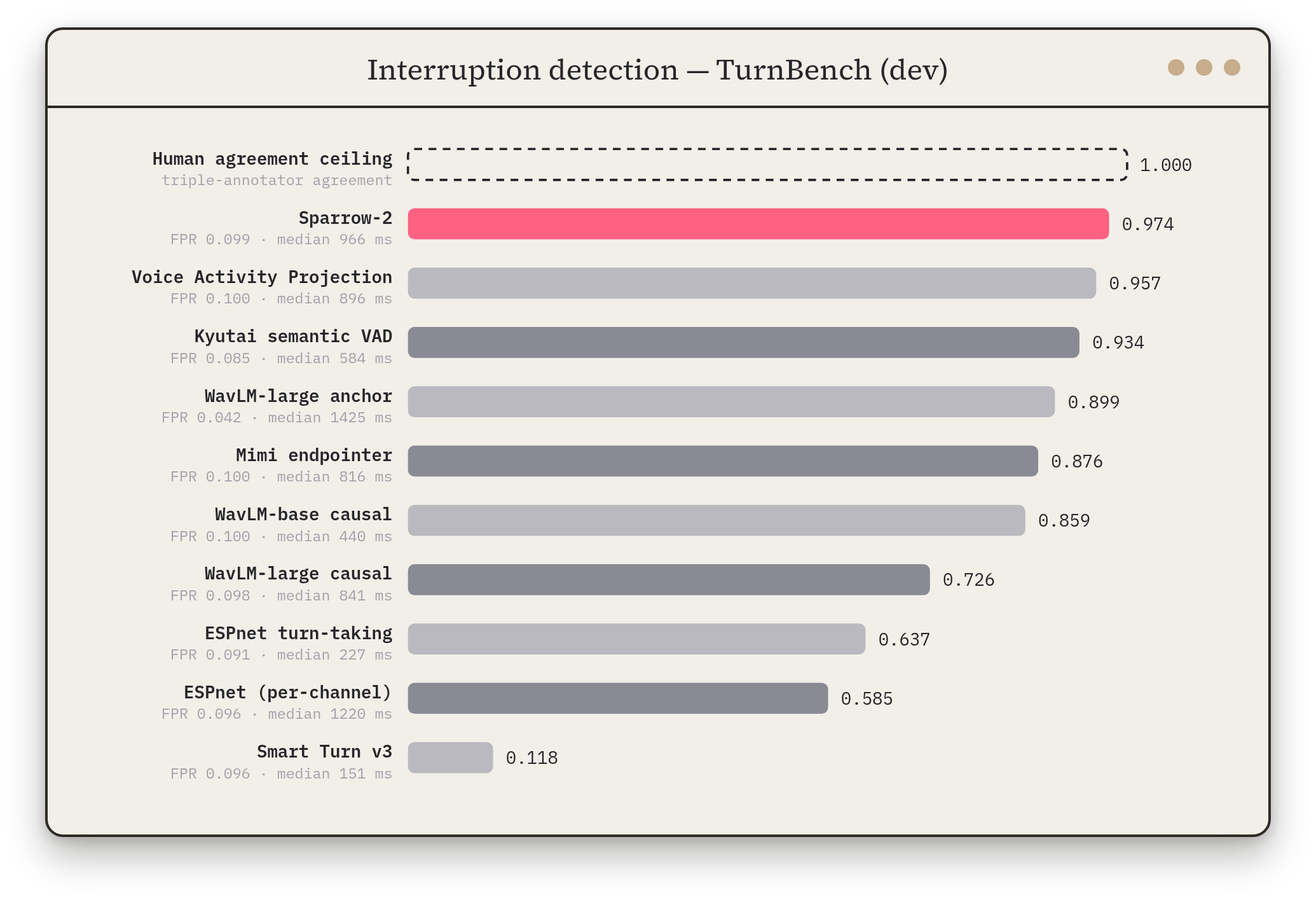
Sparrow-2 is the #1 turn-taking model in the industry. On TurnBench, the independent benchmark of real human conversation, it leads all fourteen published systems in both end-of-turn detection (92.4% recall) and interruption detection (97.4% recall) — the only model to lead both.
Human conversation relies on a largely subconscious understanding of speaker intent, prosody, and the acoustic environment. We continuously interpret what another person is saying, how they are saying it, and where they are in a thought to determine when to respond.
Machines have historically struggled to model this. Prior systems reduced turn-taking to endpoint detection (through silence timers or acoustic end-of-turn models) and relied on noise cancellation to isolate the primary speaker, stripping away the broader acoustic environment in order to produce a clean signal for those systems to interpret.
This is the same underlying challenge humans solve effortlessly in a crowded room: not simply hearing sound, but understanding which signals belong to the conversation and what they mean. Humans do this continuously and naturally. Machines historically could not, so conversational systems made the same fundamental trade in both turn-taking and audio processing: discard information before the system ever had a chance to understand whether it mattered.
Sparrow-2 inverts this approach. Rather than filtering the audio stream down to a clean signal from the primary speaker, it treats the entire incoming audio stream as evidence of the conversational state. Rebuilt from the ground up, Sparrow-2 jointly models semantic content, lexical structure, prosody, speaker identity, backchannels, interruptions, and more, alongside signals from the broader audio environment, including background speech, noise, and unintelligible audio. Together with the PAL’s own speaking state, modeled through a semi-duplex architecture, these signals inform both when the system should listen, wait, speak, or continue speaking, and how it should respond to what is happening around it.
The result is a model that pushes the frontier of turn-taking accuracy, but expands conversational AI beyond the quiet, one-speaker environment it has historically required. Sparrow-2 can distinguish nearby speech from someone actually talking to it, understand when background noise matters, and recognize when audio is too unclear to answer confidently. Together, these capabilities represent a new approach to the cocktail party problem and unlock conversational AI across cafés, retail floors, open offices, cars, healthcare settings, and other noisy or shared environments that were historically impractical.
Conversation is a dance. Not metaphorically: mechanically. Two partners, in continuous negotiation over a shared floor: when to lead, when to follow, when to hand the moment across. We don’t always know when to speak, but we feel it. And like a dance, a conversation doesn't just start or stop: it flows like a spin, a dip, a twirl. Each partner inherently knows their next step, not by watching for the other to finish moving, but by understanding movement itself. Inertia, timing, collision. The physics of conversation, like the physics of dance, naturally shape a shared subconscious rhythm. This is not heuristic, it’s holistic.
Conversation flow is the choreography of human interplay: the protocol for when to speak, when to listen, when to trade the floor, and what in the world around us actually matters to the interaction - running underneath every conversation you've ever had, so smoothly you've never once thought about it. But it’s a consistent and natural phenomenon that can be learned.
The timing works because each party is continuously reading the whole interaction: the movement, the partner, and the space around them.
Conversation works the same way. You know which voice belongs to the person you are speaking with. You know whether a “woo!” is encouragement, an interruption, or someone speaking across the room. You hear the door close, the next song start, another conversation nearby, a breath, a hesitation- and each signal carries a different weight. Some should change the dance. Some should be ignored. Some tell you to wait, some to respond, and some tell you that you did not hear clearly enough to respond at all.
None of these signals are inherently noise. Some matter, some do not, and their meaning changes with the conversation. The environment is not separate from the interaction; it is part of the context that gives each signal meaning. Humans understand enough of the whole scene to know the difference.
A good dance partner does not stare at your feet and wait for you to stop moving. They understand the movement as it unfolds- and the room around it- well enough to know what comes next. Conversation works the same way. Listening is not waiting for someone to finish. Listening is understanding.
Conversational AI has historically modeled this very differently. Understanding the full state of a live conversation was simply too difficult to model in real time, so the problem was reduced into smaller, tractable objectives.
That reduction happened in two directions. The objective was narrowed from understanding conversational state to detecting when someone had finished speaking. At the same time, the input was narrowed from the full acoustic scene to a clean signal from the presumed primary speaker.
Each made the problem easier to solve. Each also removed information humans naturally rely on to understand what is happening.
For turn taking, that decomposition centered the objective around detecting an ending. Typical pipelines cascade audio to ASR to transcript, sometimes with prosody features, and then apply either a silence timer or an end-of-turn classifier trained on the final few hundred milliseconds of audio.
Sparrow-1 represented the state of the art in that paradigm: rather than waiting on a fixed silence threshold, it incorporated tone, rhythm, hesitation, and other acoustic cues to model floor transfer directly. But even Sparrow-1 was ultimately optimized around the same question: has the speaker reached the end of their turn?
The ceiling of this approach is empirical, not a matter of tuning. Across more than one million silences in natural conversations, the probability that a pause marked a true turn handoff plateaued around 40%. Most pauses are simply part of speaking- thinking, breathing, searching for a word- not an invitation for someone else to jump in. That makes silence alone a fundamentally weak signal for deciding when an AI should speak.
No silence duration, at any threshold, reliably indicates that the floor has changed hands. More sophisticated end-of-turn models add acoustic cues, but still optimize for detecting an ending rather than understanding conversational state, forcing the same tradeoff: respond aggressively and interrupt, or wait conservatively and introduce unnatural latency.
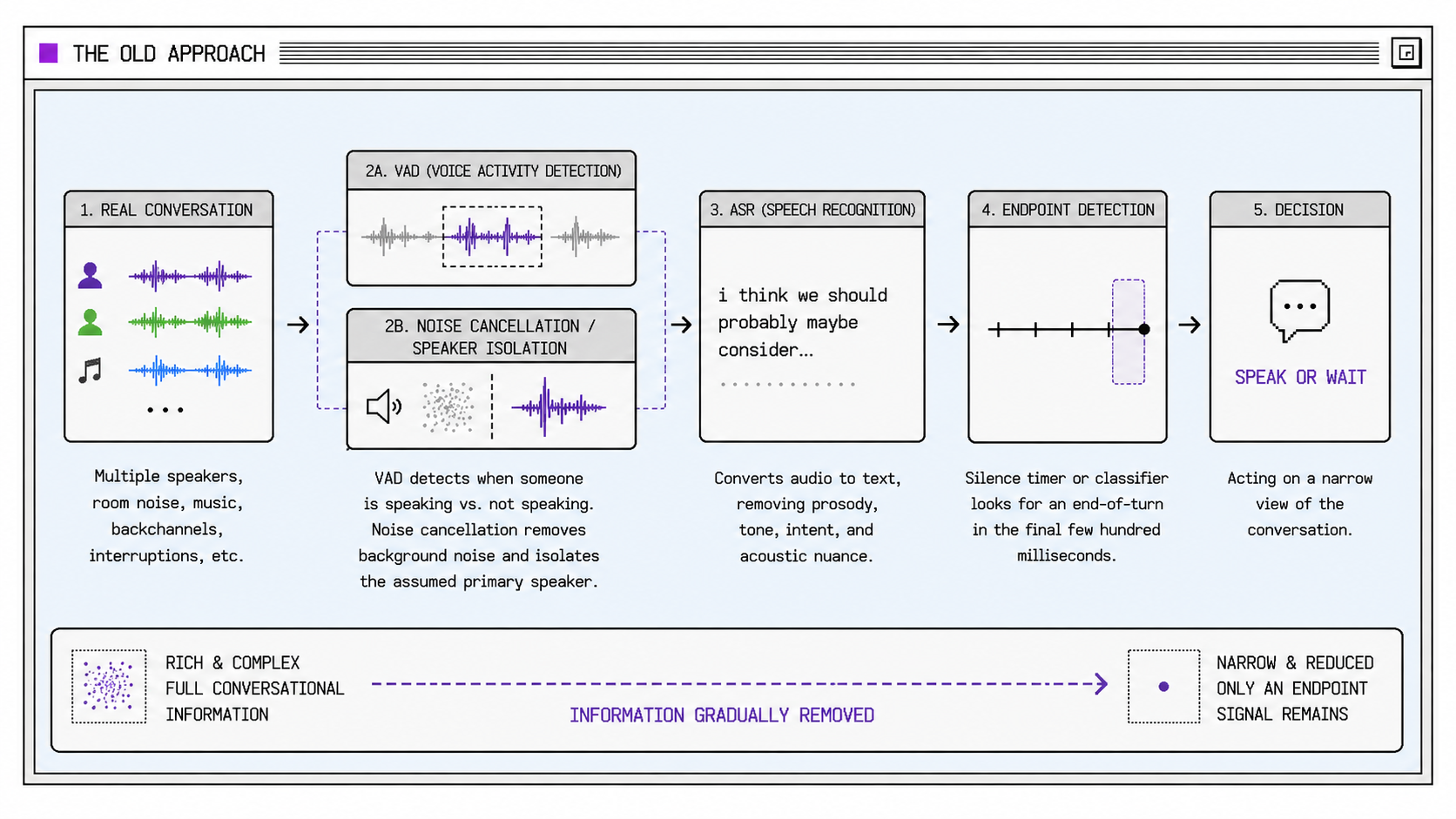
The same reduction that narrowed the objective also narrowed the input. To make speech recognition and turn detection reliable, conversational systems came to depend on clean audio. Noise cancellation isolates the presumed primary speaker and suppresses everything else before downstream models ever see it.
That works when the system gets it right, but when it does not, the failure is absolute: the real speaker can be cancelled along with the noise. The audio is gone, the transcript is gone, and the system is no longer mishearing the user- it is not hearing them at all.
More importantly, even successful cancellation comes at a cost. Background speech, breaths, sighs, backchannels, interruptions, and environmental sounds- the very cues humans use to dance- are discarded before the system has a chance to determine whether they matter.
That is the deeper limitation of cancellation: it decides what matters before understanding what it is. A backchannel becomes noise. A second speaker becomes interference. A loud room disappears entirely. In simplifying the audio enough for downstream systems to interpret, we also remove the context they would need to understand the conversation more completely.
Both reductions make the same trade: throw away information to make the problem tractable.
This is the cocktail party problem hidden inside the conversational AI stack. Humans do not solve a crowded room by deleting every sound except one voice; we continuously decide who is speaking, what is directed at us, and which parts of the acoustic scene matter. Traditional systems had to decide what was noise before they understood what was happening.
Sparrow-2 takes a step back and asks whether we still need to make that trade at all.
Sparrow-2 is an audio-native, streaming-first, multilingual conversational understanding model built to preserve the full audio scene, understand it, and let conversational decisions emerge from that understanding.
Rather than reducing the interaction to isolated signals, Sparrow-2 takes a rich multi-objective approach to the entire audio space. The question shifts from “has the user finished speaking?” to “what is happening in the conversation, and what should the system do next?”
That paradigm shift expands the model in two directions:
This fundamentally changes what a conversational system can understand in practice.
An “mhm” while the PAL is speaking can be understood as a backchannel telling it to continue, while a genuine interruption can tell it to stop. Speech elsewhere in the room can be distinguished from someone actually trying to take the floor. And when audio is too noisy or unclear to understand reliably, the system can recognize that uncertainty and ask the user to repeat themselves rather than confidently responding to something it did not hear.
Together, these changes move conversational flow from endpoint detection toward continuous conversational-state modeling: a single system reasoning over more of the information humans naturally use to decide when to listen, wait, speak, or respond.
The result is not only more natural conversational timing. By understanding rather than cancelling the broader acoustic scene, Sparrow-2 can operate across noisy, shared, and uncontrolled environments that historically broke conversational systems, while navigating pauses, backchannels, interruptions, hesitation, and ambiguity with substantially more human-like conversational behavior.
Sparrow-2 is built around a richer representation of conversational audio, allowing it to push the boundaries of conversational AI in two directions at once:
The shift is possible because Sparrow-2 no longer has to choose between rich audio understanding and real-time inference. A new Tavus encoder preserves semantic, lexical, prosodic, speaker, and environmental information in a shared representation, which a causal transformer reasons over continuously in real time.
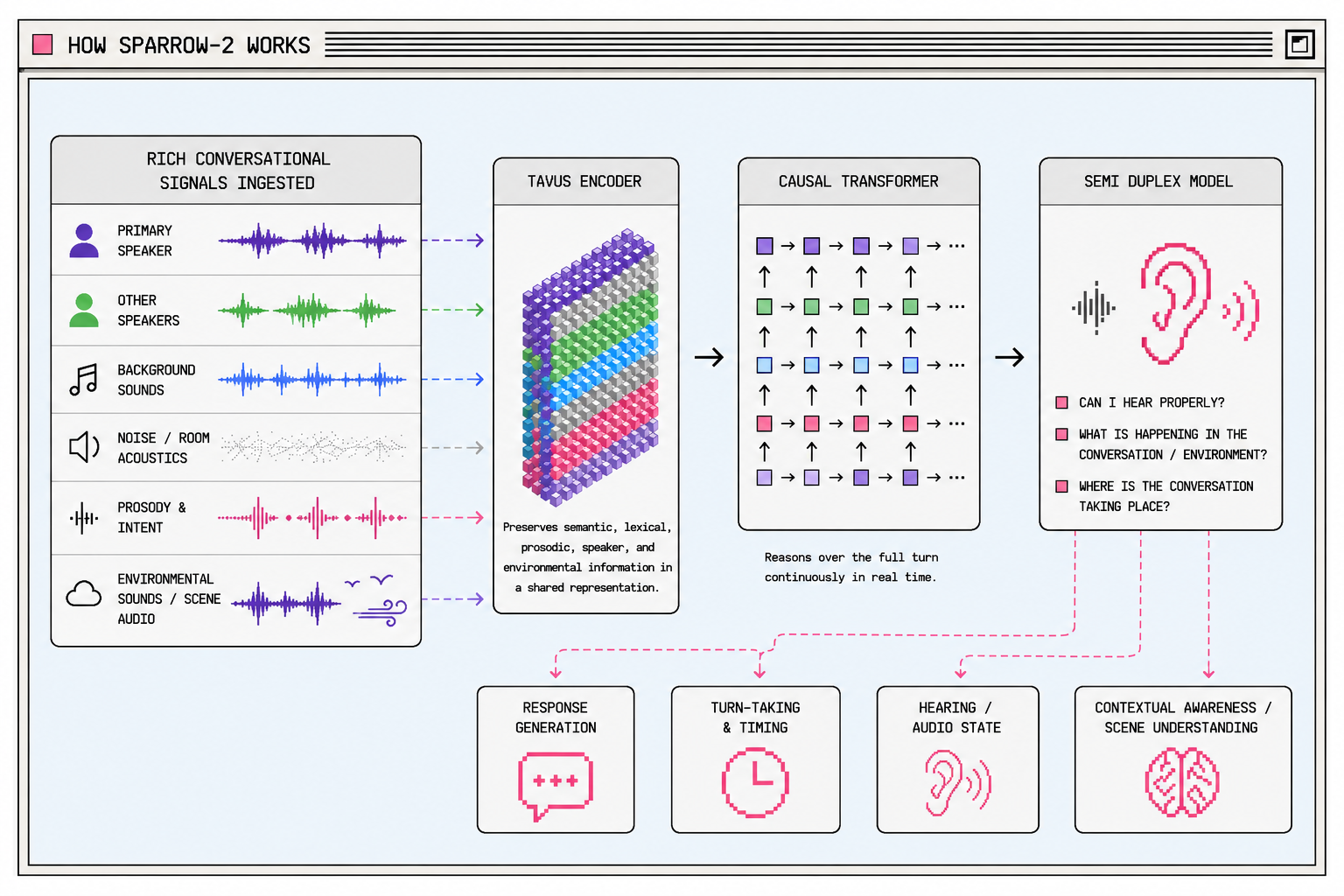
Sparrow-2 retains Sparrow-1’s speculative inference, real-time speaker adaptation, and core design for real human speech, while expanding capabilities substantially.
Together, these capabilities unlock more natural conversations in more real-world conditions- from longer pauses and nuanced interruptions to noisy rooms, shared spaces, and less structured interactions.
[Test Sparrow-2 Demo Environment >]
Raw audio passes through a Tavus encoder that projects multiple conversational objectives into a shared latent space, encoding lexical content, full sentences, and linguistic meaning. A six-layer causal transformer runs on the resulting streaming embeddings at a native 10 ms frame rate, producing an updated judgment of conversational state at every frame.
The model was trained using 16,000 real and 2,000 synthetic conversations with backchannels, interruptions, and other conversational behaviors explicitly represented. These objectives are learned jointly. There is no silence timer anywhere in the system
Sparrow-2 breaks through one of conversational AI’s biggest constraints: the cocktail party problem. It expands conversational AI beyond the quiet, one-speaker environment it has traditionally required.
With noise understanding, a kiosk can hold a conversation in a busy lobby without treating every nearby voice as the user. A retail assistant can operate on a shop floor with music, customers, and staff talking around it. A candidate can take an interview from a café or shared room without background speech constantly breaking the interaction.
And in any conversation, a PAL can recognize that the user is in an environment too loud to understand reliably and ask them to move or change microphones- just like a human would.
The same applies to open offices, healthcare environments, cars, public spaces, and other settings where conversational AI has historically been unreliable because the acoustic scene could not be cleanly isolated.
This materially expands the deployment surface for conversational AI: use cases no longer have to be designed around a quiet room.
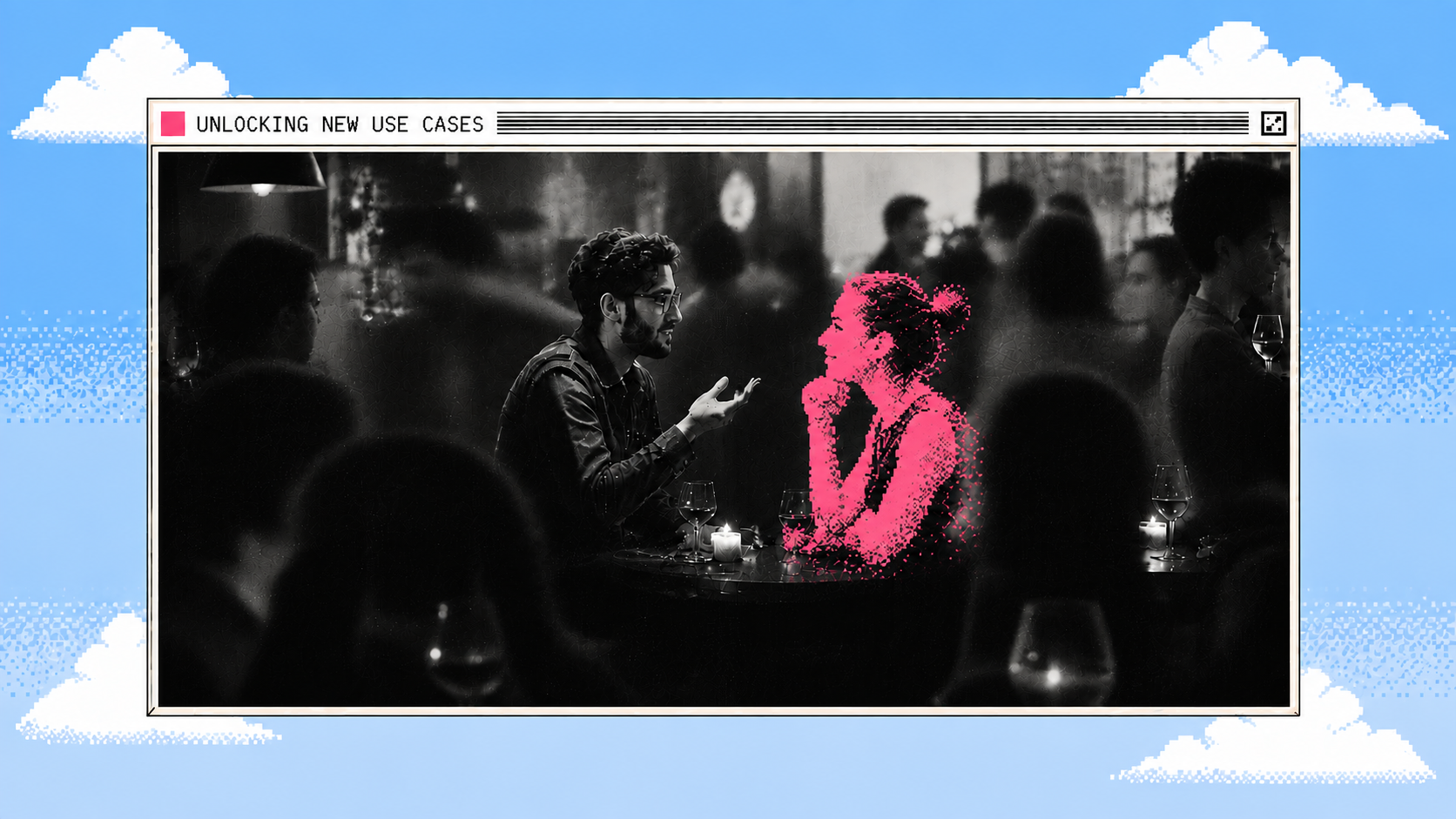
Sparrow-2 also changes what is possible inside the more controlled environments conversational AI already serves.
Users can pause for several seconds to think without being interrupted. They can say “mhm” or “yeah” while the system is speaking without accidentally stopping it. They can interrupt naturally when they actually want the floor. They can trail off, restart a sentence, search for a number, or speak unclearly without breaking the flow.
And when the system genuinely did not understand something, it no longer has to guess. It can admit it didn’t hear you and ask you to repeat yourself.
In an interview, a five-second pause can mean the candidate is thinking, not finished. In intake, interrupting mid-thought can mean losing information entirely. In sales or support, a backchannel should encourage the speaker rather than accidentally take the floor. Across interviews, intake, onboarding, support, sales, coaching, and education, this changes what conversational AI can be trusted to do. In interviews and intake, people can think without losing the floor.
In sales and support, natural feedback no longer breaks the interaction. Across coaching and education, people can speak the way they naturally would instead of adapting their behavior to the AI.
The result is conversational AI that can absorb the messiness of real human speech without losing the rhythm of the conversation.
Sparrow-2 is built to understand what is happening in a conversation as a whole, from turn-taking and interruptions to the broader acoustic scene around it. By reasoning over that full scene, it takes a new approach to the cocktail party problem, allowing conversational AI to work more reliably in noisy, shared, real-world environments. The evaluations below focus on just one part of that broader problem, turn-taking, where we can compare directly against existing systems on real conversational audio.
Industry metrics such as time-to-first-token measure how fast a system speaks, not whether it spoke at the right time. So we scored turn-taking the way you would judge a listener: on real human conversations, against what real people did on those same turns.
And rather than grading ourselves on a benchmark we built, we ran Sparrow-2 on TurnBench (Sesame AI Labs, arXiv 2608.25218): an independent, triple-annotated benchmark of real human conversation with an open scorer, a public leaderboard, and a published field of fourteen systems spanning research models and the production detectors most voice agents ship today. Every baseline below is scored from its own committed predictions using the benchmark's official scorer, alongside Sparrow-2.
One note before the charts: these are preliminary results on TurnBench's public dev split (38 conversations, 7.3 hours of audio). The benchmark's test set is private and scored by its maintainers on submission. We will publish our full test-set results as soon as they are returned.
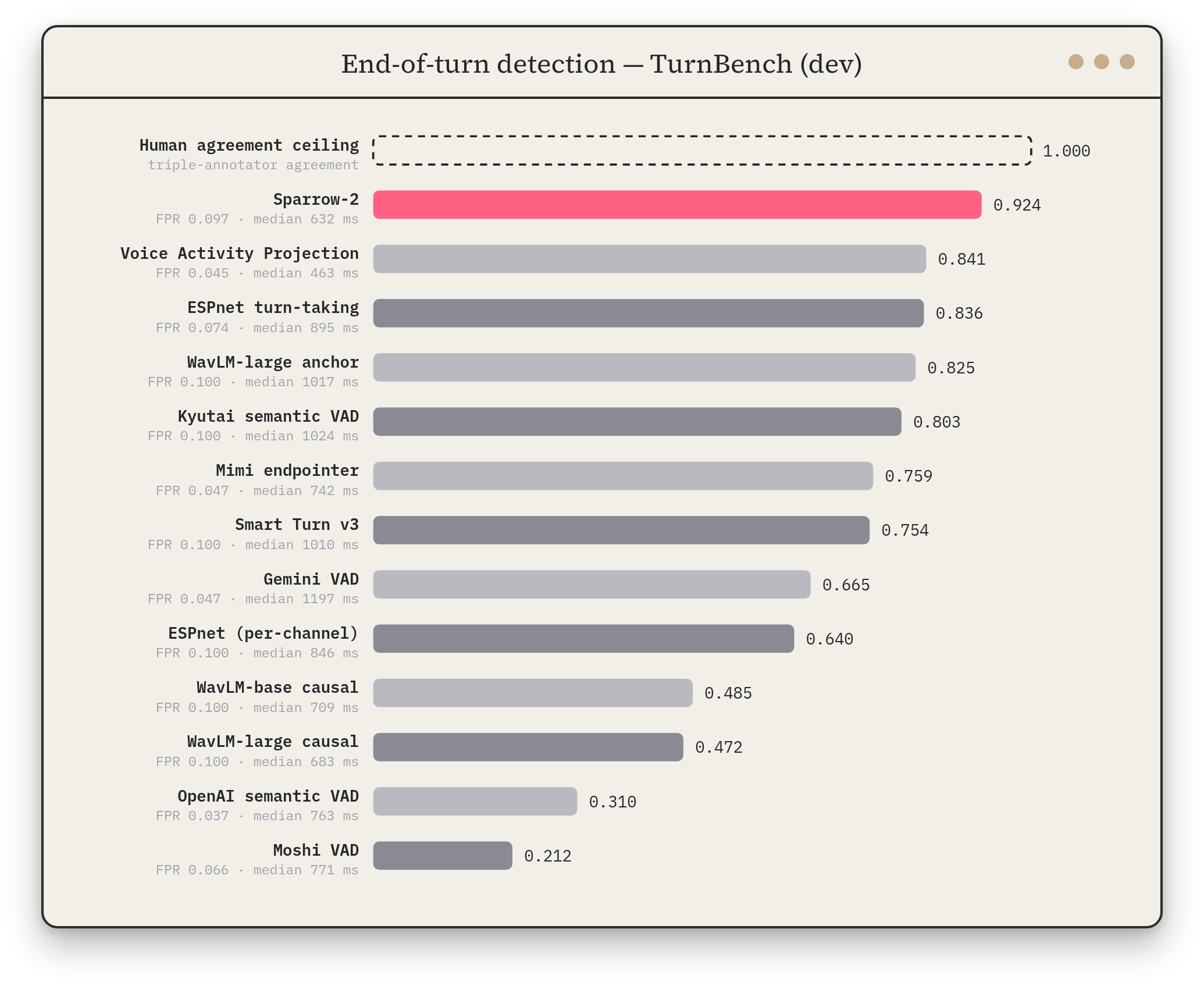
On the dev split, Sparrow-2 posts the highest end-of-turn recall in the published field (92.4%, with the runner-up at 84.1%) and the highest interruption recall (97.4%). It is the only system to lead both tasks.
Sparrow-2 detects 92.4% of true turn ends, leading the entire published field: 8 points clear of the strongest baseline (Voice Activity Projection) and 17 clear of Smart Turn v3, at a false-positive rate inside the benchmark's qualification ceiling and a 632 ms median decision. The dashed bar is the human-annotator agreement ceiling. These are preliminary results on the benchmark's public dev split; we will report full test-set results once the maintainers score our submission.
TurnBench also scores the other half of turn-taking: recognizing the moment a listener takes the floor. Sparrow-2's interruption classifier catches 97.4% of true interruptions, the best result in the field and ahead of every research system on the benchmark, while the end-of-turn detectors most voice agents ship today barely register the task (Smart Turn v3: 11.8%). Preliminary dev-split results; full test-set results to follow.
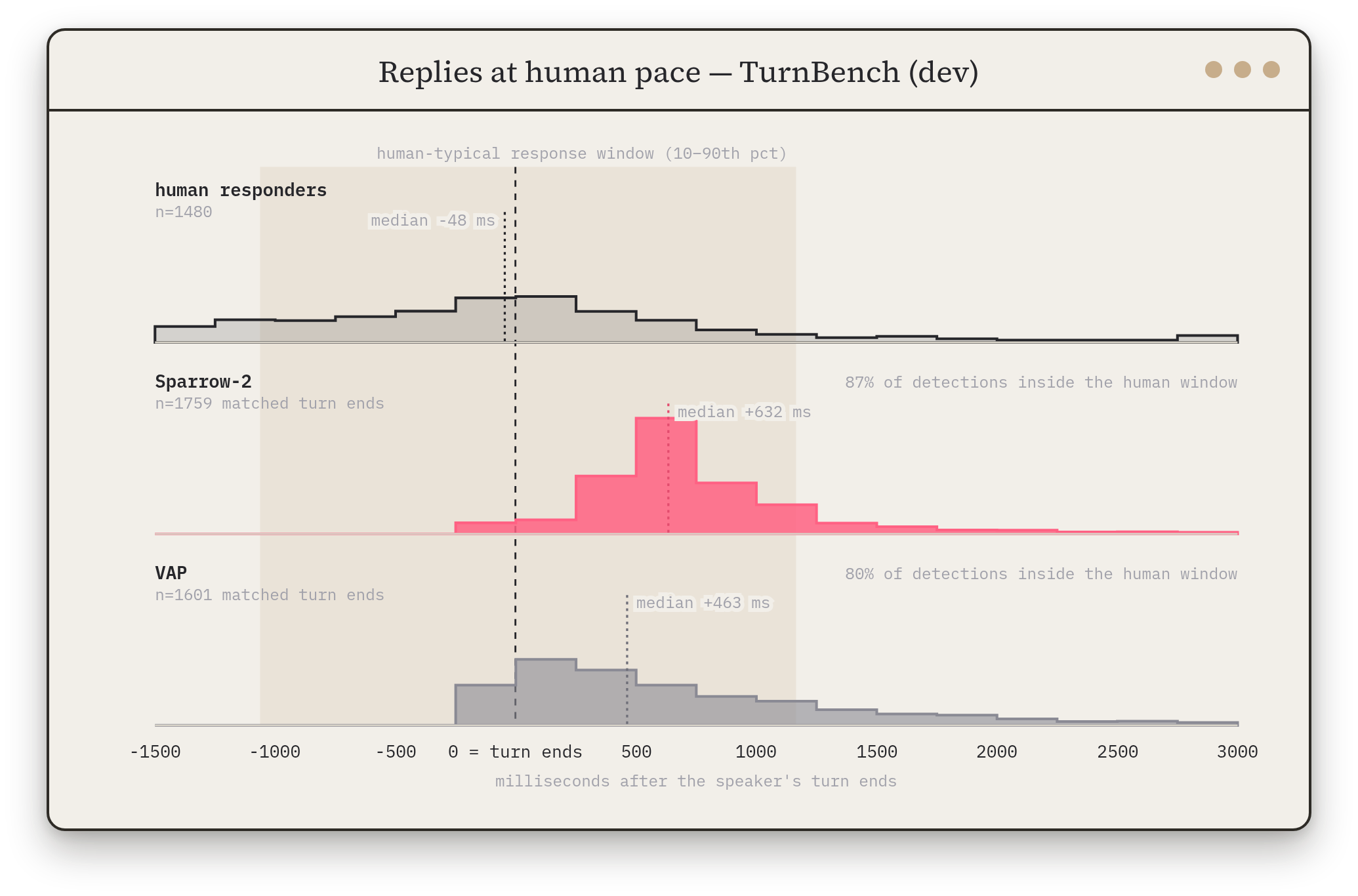
How fast is fast enough? We measured every human floor transfer in TurnBench's dev conversations: the median human responder starts speaking 48 ms before the other person's turn ends, and over half of all human responses begin in overlap. The benchmark's own annotation study reports the same phenomenon. The shaded band is the human-typical response window, the middle 80% of human replies.
Sparrow-2's detections concentrate in a tight band just after the boundary (median 632 ms), with 87% inside the human window. Counting the turn ends it misses, it answers 81% of all turn ends at human-typical timing. Voice Activity Projection, the strongest research baseline, posts a faster median (463 ms) but smears from before the turn ends to a tail past 2.5 s and misses 16% of turn ends outright, so only 67% of all turn ends get a human-timed answer. Consistency, not just speed, is what makes an agent feel natural. Preliminary dev-split results; full test-set results to follow.
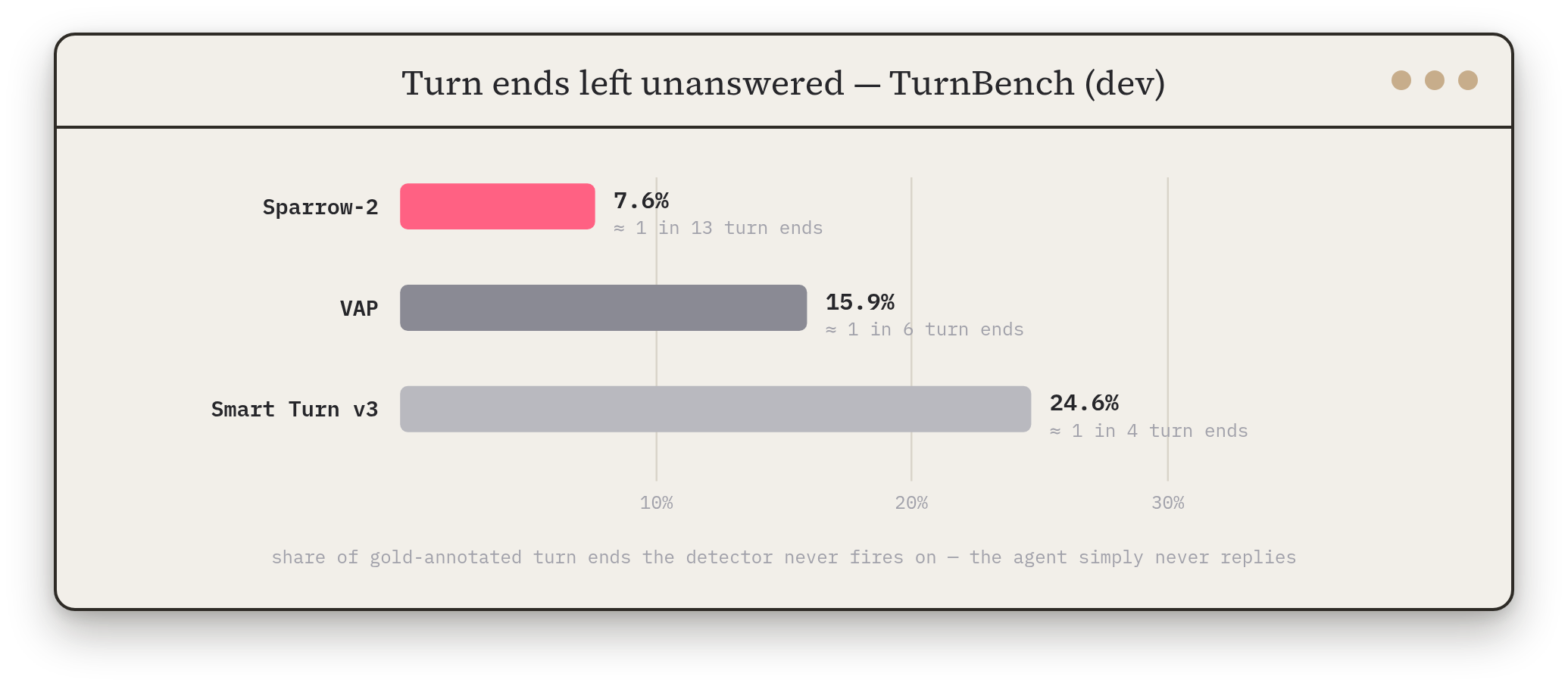
A latency histogram only shows the replies that happen. This is the other side: the share of real turn ends where the detector never fires at all. The user stops talking and the agent simply never responds. Sparrow-2 leaves 7.6% of turn ends unanswered, about 1 in 13. VAP, the strongest research baseline, leaves 1 in 6. Smart Turn v3, the detector many production agents ship today, leaves 1 in 4. Preliminary dev-split results; full test-set results to follow.
For decades, interfaces have required people to learn how machines work. Conversational AI inherited the same pattern: wait for the beep, avoid background noise, do not pause too long, speak one at a time.
These are not natural conversational behaviors, whether in a one-on-one interaction or a crowded social setting. They are accommodations for the system. The more a person has to think about how to speak to the machine, the less the interaction feels like conversation at all.
The real benchmark for conversational AI is not latency alone. It is whether the interaction creates the same sense of being heard that we expect from a good listener- or rather, a shared rhythm we’d expect from a dance partner.
We trust people who do not interrupt us while we are thinking, who wait when we hesitate, who understand when a quick backchannel means “keep going,” and who admit when they did not hear us clearly enough to respond. These behaviors feel small, but together they are how attentiveness- and ultimately trust- is felt in conversation.
Our goal with human computing is to reverse the relationship between people and machines: instead of having to learn how to interact with machines, teach the machine how people already behave.
Sparrow-2 moves us closer to that goal, enabling more natural conversational flow while expanding conversational AI into environments and use cases that previous systems could not reliably support.
Sparrow-2 is now available to GA across PALs, the Tavus APIs and platform, already powering conversational experiences in the Tavus PALs and enterprise deployments.
Try the demo at sparrow2.tavuslabs.org or learn more in our docs.