How Elevare Health uses AI to close the postpartum care gap

Written by

The Tavus Team

Learn how Elevare Health partnered with Tavus to build an AI care companion that gives mothers continuous, empathetic support from pregnancy through the first year postpartum, for the moments the traditional system doesn't cover: after discharge, between visits, at 3 a.m.
"When we think about our use case, we are driving socially intelligent agents, the ability to increase engagement and adherence in the customer segment we're serving. Tavus lets us use emotion tags that represent different emotional states of the model, and use the perception model to detect emotion from the user and respond appropriately. That's something none of the other vendors we evaluated do well."
— Kayla Walsh, Founder & CEO, Elevare Health
Elevare Health is clinical AI infrastructure for maternal care, spanning pre-conception through one year postpartum. The platform extends care before intake, between visits, and after discharge, reasoning continuously over clinical guidelines, patient-reported symptoms, behavioral signals from Elevare's patient app, wearable streams, and EHR risk data, then directing each patient to the next best care action.
A human care team stays in the loop, and Elevare escalates to one-to-one clinical attention through a proprietary protocol engine. The PAL doesn't diagnose and doesn't replace a clinician. Elevare's care team makes every decision, and the platform extends a shrinking women's health workforce instead of replacing it.
American prenatal care spans the 40-week arc of pregnancy in 12 to 14 office visits, a schedule that hasn't changed since the Children's Bureau published it in 1930. Then the baby arrives, and the care mostly stops.
That timing is backward from where the risk actually sits. CDC Maternal Mortality Review Committee data across 45 US states shows 37.8% of pregnancy-related deaths occur between 43 and 365 days postpartum, and 53% occur between seven days and one year after birth.
Mental health conditions, including suicide and overdose, are the single leading underlying cause of pregnancy-related death at 22.7%, ahead of hemorrhage and cardiac conditions. And across all pregnancy-related deaths, 84% are judged preventable.
The industry standard for catching a perinatal mood disorder is a six-week postpartum visit. One visit, often with a stranger.
"When everything in your world is telling you that you should be focused one hundred percent on caring for a new life, how are you supposed to say, 'I need help, and I'm struggling with this'? It's completely inconsistent with what a lot of women feel to be the priority in the postpartum period."
Kayla Walsh, Elevare's founder and CEO, has interviewed more than 300 birth workers to understand the workflows and constraints behind the postpartum care gap. One conversation she recounts is with a maternal-fetal medicine specialist, a subspecialist obstetric provider whose entire job is this category of risk.
"She said, 'I knew this was a risk, and still after I had my first, I was sitting at the top of the staircase, and either one or both of us were going down the stairs. I didn't know which one.' Despite her being, it's not a problem of education or knowledge. It's a problem of support."
The founding story runs deeper than clinical observation. Walsh grew up in rural northern Nevada. Her mother's postpartum depression and anxiety went untreated after her younger brother and sister were born, and led to a methamphetamine addiction.
.avif)
"I've seen the way that gaps in care in the postpartum period wreaked havoc on families in this country. It shaped who I am."
Walsh went to West Point, served as a leader, majored in systems engineering, and flew the Black Hawk for eight years on active duty. She had her first daughter at the tail end of that service.
"I saw the way that women in the postpartum period navigate pregnancy and care with worse care infrastructure than we have in combat zones."
Before founding Elevare, Walsh built data infrastructure for LLMs at Amazon and led a multilingual improvement strategy focused on fluency and cultural fluency for the regions where each language is actually spoken.
That background shapes how she thinks about a related problem: maternal care quality carries deep socioeconomic and racial disparities, and CDC data shows Black women die of maternal causes at 3.2 times the rate of white women, 44.8 versus 14.2 deaths per 100,000 live births. Her read on part of the answer is direct: "Care needs to look like the patient."
.avif)
Elevare's PAL runs on Tavus, the human computing company, and sits front and center in the patient app, always available. A patient can toggle the face off for voice-only or text, and the conversation continues either way. Video presence is the default, powered by Tavus's conversational video AI, and the choice is clinical.
The bet has an evidence base. In a controlled experiment at USC's Institute for Creative Technologies, people who believed they were disclosing to a computer rather than a human operator reported significantly less fear of self-disclosure and were rated by observers as meaningfully more willing to disclose.
Both groups were talking to the same virtual human. The only difference was who they thought was behind it.
In follow-up research, US service members returning from Afghanistan reported more mental-health symptoms to a virtual human interviewer than on the official Post-Deployment Health Assessment, or even on an anonymized version of it. Anonymity alone didn't explain the gap in reporting; rapport did.
Read precisely, that research says something narrower than "video beats text": a patient will tell a machine what she won't tell a person, and a conversational presence gets more out of her than a form does. Elevare's bet is that the rapport, not just the anonymity, is what carries the effect, and rapport is where the face earns its place.
"There's the ability to have a care presence that does not judge, that listens infinitely, and is patient. You're not worried about fear of judgment on the other end if you say, 'I'm having feelings of wanting to strangle my baby.'"
The second half is infinite time, which makes this scalable and accessible for the mothers who need it most.
"A care navigator that has effectively infinite time to listen. It takes a beat to get to that point. To think through what you're actually feeling. To express what you're struggling with."
Walsh recounts a patient who sent her care team hundreds of messages a day. The questions read as anxious noise: Is walking going to hurt my baby?
In her third trimester, that patient died by suicide.
"What she was actually saying was not, 'Am I going to hurt my baby by walking?' She was asking: Am I unwell? Am I sick? And if her care team could have picked that up, in the patterns of how many questions and what kind of questions, if they could have detected that risk earlier and elevated it to the right level of mental health support, they could have saved two lives."
Detecting the dissonance between what a patient says and how she says it sits at the center of Elevare's product.
"Sometimes when we say things, we express the opposite. We're not saying what our words are saying. The ability to use Tavus to create a moment where we can read the dissonance and infer what a person is really saying, that's what we're excited about."
Elevare evaluated multiple vendors before choosing Tavus, and the comparison came down to four requirements, three of which are conversational-quality problems that only surface under real conditions.
1. Emotion had to run in both directions
Tavus emotion tags let Elevare's PAL express distinct emotional states, and Raven-1's perception model fuses tone and expression from the patient, catching the emotion coming back, something Walsh says none of the other vendors evaluated did well.
2. Turn-taking had to feel natural
Tavus's conversational flow model, Sparrow-2, decides when to speak and when to hold, which matters because a system that interrupts a woman mid-disclosure has destroyed the exact thing it exists to create.
"There's a lot of nuance to understand when to speak and when to hold. It yields greater trust if you do it right."
3. Latency had to stay low enough that a pause never reads as judgment
"Making sure it's not awkward when you ask a question; that there's an appropriate response time to keep the conversation going," she says.
4. The PAL had to keep working through real-world noise
This requirement eliminated other vendors outright.
"In the postpartum period you have a noisy baby, you have things going on around you, you're busy. If you turn it on and it can't listen because there's ambient noise in the background, that's a non-starter for us."
Those four requirements narrowed the field to one vendor.
"We are an early-stage startup, and Tavus worked with us to find a structure that is appropriate for our stage but also grows with us, and gives us the technical support to execute well in our early partnerships without gouging our cash flow."
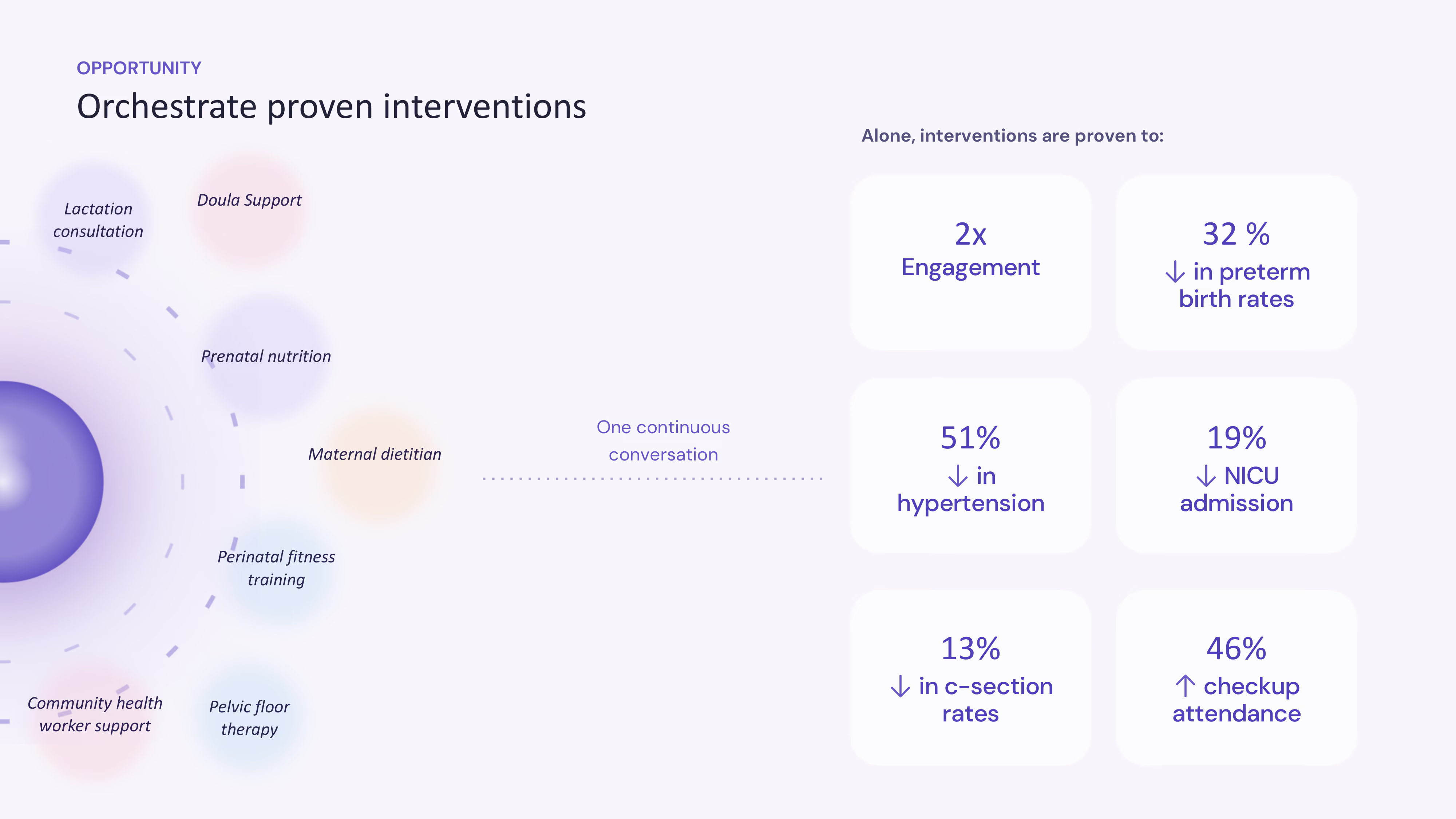
Elevare is working toward reduced preterm birth, fewer hypertensive crises, fewer NICU admissions, lower C-section rates, higher postpartum visit attendance, and improved breastfeeding self-efficacy. The clinical case for continuous support already has evidence behind it:
The economics explain the stakes. Maternal morbidity from a single year's US births costs $32.3 billion through the child's fifth birthday, or $8,624 per mother-child pair, with 58% borne by the healthcare system. The largest single cost driver is maternal mental health conditions, at $18.1 billion, the exact category Elevare's PAL is built to address.
Elevare's model is a triad of patient, care team, and PAL, and Walsh bets the triad generalizes well beyond maternal care. The plan runs in two directions: along the arc of a woman's life, from first menstrual period through perimenopause and menopause, and across clinical verticals, licensing the platform into oncology, musculoskeletal, and cardiometabolic care, anywhere between-visit data changes the next clinical decision.
"I started this company because my family lived what happens when the postpartum period goes unsupported. The ability to deliver care that looks and sounds like the patient, that increases symptom disclosure, directs people to the next best action, and improves outcomes at a lower cost, that's what this technology unlocks. There are real limitations, and you need a healthy respect for both the power and the limits. But care is innately human, and we have to use technology to fix it. That's exactly what software does well: scale."
— Kayla Walsh, Founder & CEO, Elevare Health
What is postpartum care, and why does it matter so much after birth?
Postpartum care is the medical and emotional support a mother receives in the weeks and months after childbirth. In the US, a large share of pregnancy-related deaths occur after the first week postpartum, and mental health conditions are a leading preventable cause, which makes ongoing support after discharge as critical as prenatal visits.
How does AI support maternal mental health between doctor visits?
An AI care companion can check in continuously between scheduled visits, track patterns in what a patient reports over time, and flag signals like changes in mood or communication that a single appointment might miss. It's designed to extend a care team's reach and support clinical judgment.
Why use a video AI agent instead of a chatbot for maternal health support?
Research on human-computer disclosure suggests people share more openly with a conversational presence than with a form, largely because of the rapport it creates. A video-based PAL with real-time emotional perception can pick up on tone and hesitation that text alone doesn't capture.
Is AI in maternal health care meant to replace doctors or midwives?
No. Tools like Elevare's PAL are built to support and extend a care team. Human providers keep every clinical decision, and the technology can catch what happens between visits and route it back to the clinicians who make the medical calls.