How Tavus is transforming continuing medical education with conversational AI: The Med Learning Group story

Written by

The Tavus Team

Written by
The Tavus Team
How Med Learning Group built an AI clinical consultant that oncologists and dermatologists keep coming back to, and what it means for the future of medical education.
"We're not doing innovation for innovation's sake. We're doing it to deliver a better outcome."
— Matt Frese, CEO & Founder, Med Learning Group
This is the story of a continuing medical education company that has spent years pursuing best-in-class technology and has now found a solution that truly transforms the HCP educational experience.
Med Learning Group has never struggled with expertise. Founded in 2013, the company built six businesses across three verticals: accredited CME, market research and outcomes work grounded in behavior-change science, and medical affairs strategy. All pointed at one goal: change how healthcare practitioners behave by giving them better information.
"The whole goal is to inform and change behavior, to change the HCP behavior."
The expertise was never the bottleneck. Translating it was.
Every accredited activity Med Learning Group produces draws on a mountain of source material: clinical guidelines, trial data, peer-reviewed literature, faculty-developed content, and slide libraries built over years in oncology, dermatology, neurology, and immunology.
"You're dealing with really heavy, deep scientific stuff… How can you get something so large and boil it down into something that's really useful and targeted?"
— Matt Frese, CEO & Founder, Med Learning Group
The challenge was distilling thousands of hours of research into something a clinician could actually use. A slide deck or a monograph forces a trade-off. It can be thorough or usable, rarely both.
A dermatologist with ten minutes between patients doesn't have time to watch an hour long program or hunt through forty pages for the one paragraph that applies to the case in front of her. And no static document can answer a follow-up question.
Med Learning Group started chasing that translation problem in 2021, building live AI avatars for association meetings: attendees would walk up to a microphone and talk to a guardrailed avatar on stage. Each version got smarter; yet, none could go deep enough.
Given the volume of knowledge required, Med Learning Group needed something that was not scripted. Anything that relied on a script could not deliver the naturalness and thoroughness that the company demanded from a solution.
Two other requirements were non-negotiable, and medicine makes both harder than almost any other field.
"Working from a medical dictionary is a big challenge."
— Matt Frese, CEO & Founder, Med Learning Group
The company also made an early, deliberate decision not to build the technology itself. "We've never been a company that thinks they can do it all on their own," Frese says. "We're one that wants to focus and work with the best of the best."
That search led to Tavus.
Tavus is the human computing company, building Personified Application Layer (PAL) systems that see, hear, remember, and respond face-to-face in real time. For a continuing medical education program, that meant a resource clinicians could actually talk to about a complex cSCC case, one that remembers where the conversation left off and answers the follow-up question, not a chatbot pinged for one-off answers.
Med Learning Group and Tavus built Ruby, a clinical consultant PAL for cutaneous squamous cell carcinoma (cSCC), aimed at dermatologists, medical oncologists, moh’s surgeons, oncologic surgeons, and radiation oncologists who manage the disease.
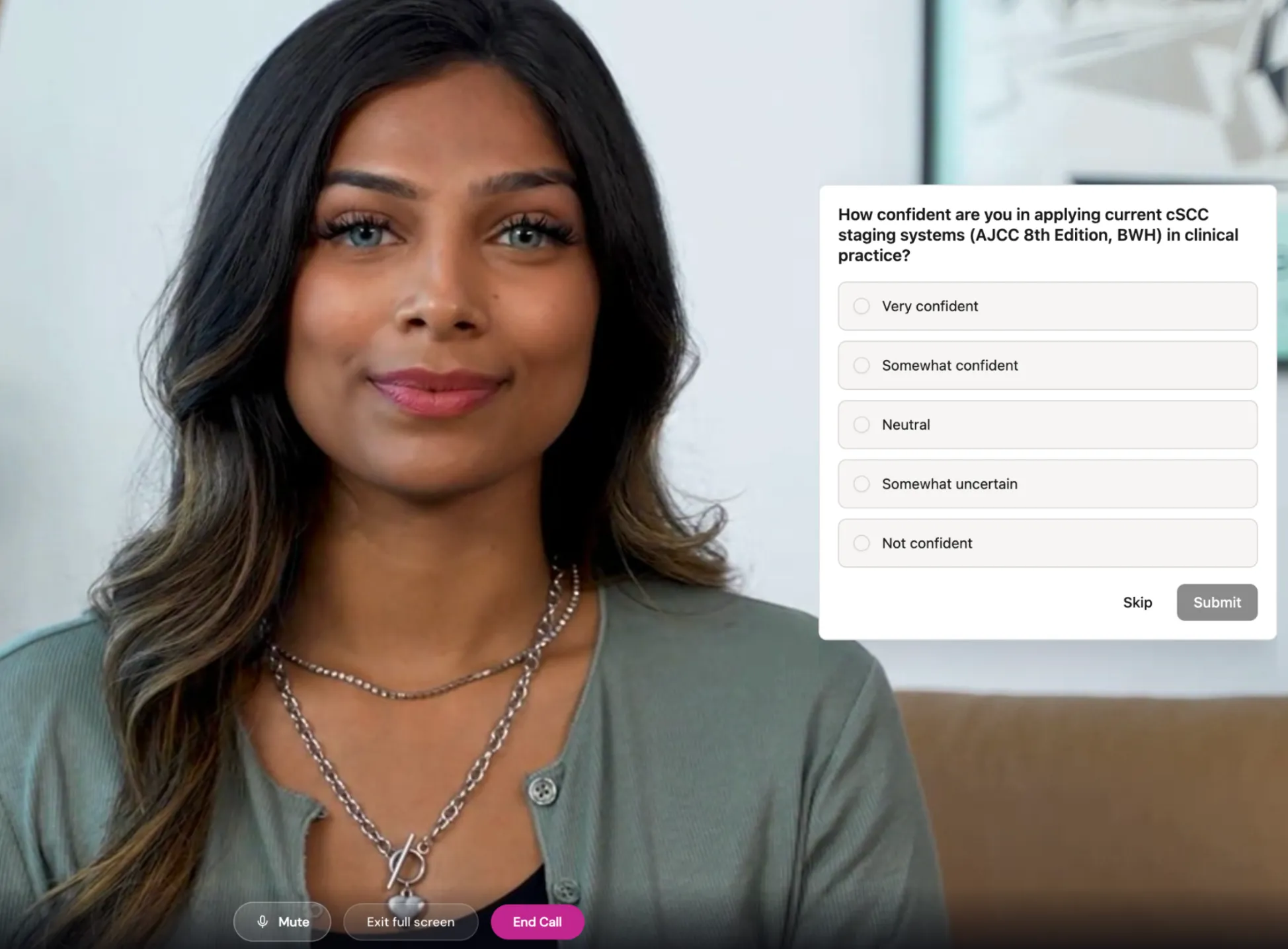
Ruby takes the hard cases. She answers questions on risk stratification and staging, adjuvant treatment criteria, immunotherapy, multidisciplinary care and adverse event management, drawing on trusted clinical guidelines, peer-reviewed literature and Med Learning Group's own faculty-developed content. "Really to make sure that they're making informed decisions with their patients," Frese says.
The AI avatar runs on Tavus's Conversational Video Interface (CVI):
That closed loop makes real-time PAL conversation possible in medical training. Three additions make it trustworthy in a clinical setting.
A clinical consultant only earns trust if it knows what it doesn't know, gets the details right, and gives Med Learning Group a way to see what's actually happening in each conversation. Three additions do that work.
1. A closed, curated knowledge base
Ruby answers from a retrieval layer built exclusively from vetted sources, currently more than 50 documents, tagged by module so she stays within the scope of a given activity while still handling adjacent questions. Ask her about a skin cancer outside her scope, and she says so instead of guessing. At the same time, the team keeps this knowledge base updated regularly.
2. A clinical pronunciation dictionary
119 terms and counting, so drug and pathway names land correctly on the first try. In medical education, mispronunciation isn't cosmetic; a consultant who stumbles over "cemiplimab" loses the room. "Working from a medical dictionary is a big challenge," Frese says.
3. Perception and reporting
Every conversation with Ruby generates structured signal for Med Learning Group's team: how clinicians engage, where they hesitate, what they ask. "As I look at my HCP, whether that's my oncologist, my dermatologist, my different specialists, I want to understand how they're interacting with the avatar,” Frese says. “So the ability to record, to understand, to break down data trends so that I can build that back and ultimately customize a product for them over time is very important."
Ruby ships in three places: as a standalone web experience, embedded inside an accredited CME activity, and on screens at live medical meetings.
The choice of video over text or voice-only chat came down to what Med Learning Group has learned about how adults actually learn. "This isn't a human; it's not meant to replace a human. But at the same time, there's a personalization that goes through this that our HCPs need; they need to feel like they're connected to something," Frese says. "Just pulling data from text or voice doesn't necessarily give you that level of comfort."
"You want people to come back and feel like, okay, I got a lot out of this. It gets to know me a little bit. It's reading my analysis. It's changing the way that it talks to me. There's something very special about that — that level of authenticity."
That instinct is also an outcomes bet. "The more people are connected to something, the better the outcomes generally are," Frese says.
The project moved on a tight clock. Tavus put project managers, business development and both founders directly on the problem. "They said, look, we'll dive right in. How can we help you? What do we need to design? Let's lay out the project," Frese says. "We had to be onboarded very quickly and really turn the switch overnight. The amount of effort that the Tavus team put in to get there in a short period of time was just amazing."
"We had to be onboarded very quickly and really turn the switch overnight. The amount of effort that the Tavus team put in to get there in a short period of time was just amazing."
Access didn't close once Ruby launched. "When we had questions, or we wanted to dive in a layer deeper, we were made available to whoever we needed to connect with at any point. There was never a point where it was like, yeah, it's going to take 48 hours for us to get back to you,” Frese says. "Truly an open door."
The first meaningful signal wasn't a usage number. It was who showed up to use the product.
Ruby launched in spring 2026. The most important feedback came from the top of the field.
"The thing that surprised me is that she's so accurate, captures what I said, and she can adapt to my question."
— Dr. Z, Community-based oncologist and Ruby user
"There's something very familiar about it because it is almost like interacting with a colleague, it's a much more natural way."
— Dr. Travis, Community-based dermatologist and Ruby user
"As I got more comfortable doing it, [I saw] very appropriate responses that were coming back that clearly are evidence-based, I think that is very useful."
— Dr. Nikhil Khushalani, Vice Chair, Dept. of Cutaneous Oncology, Moffitt Cancer Center
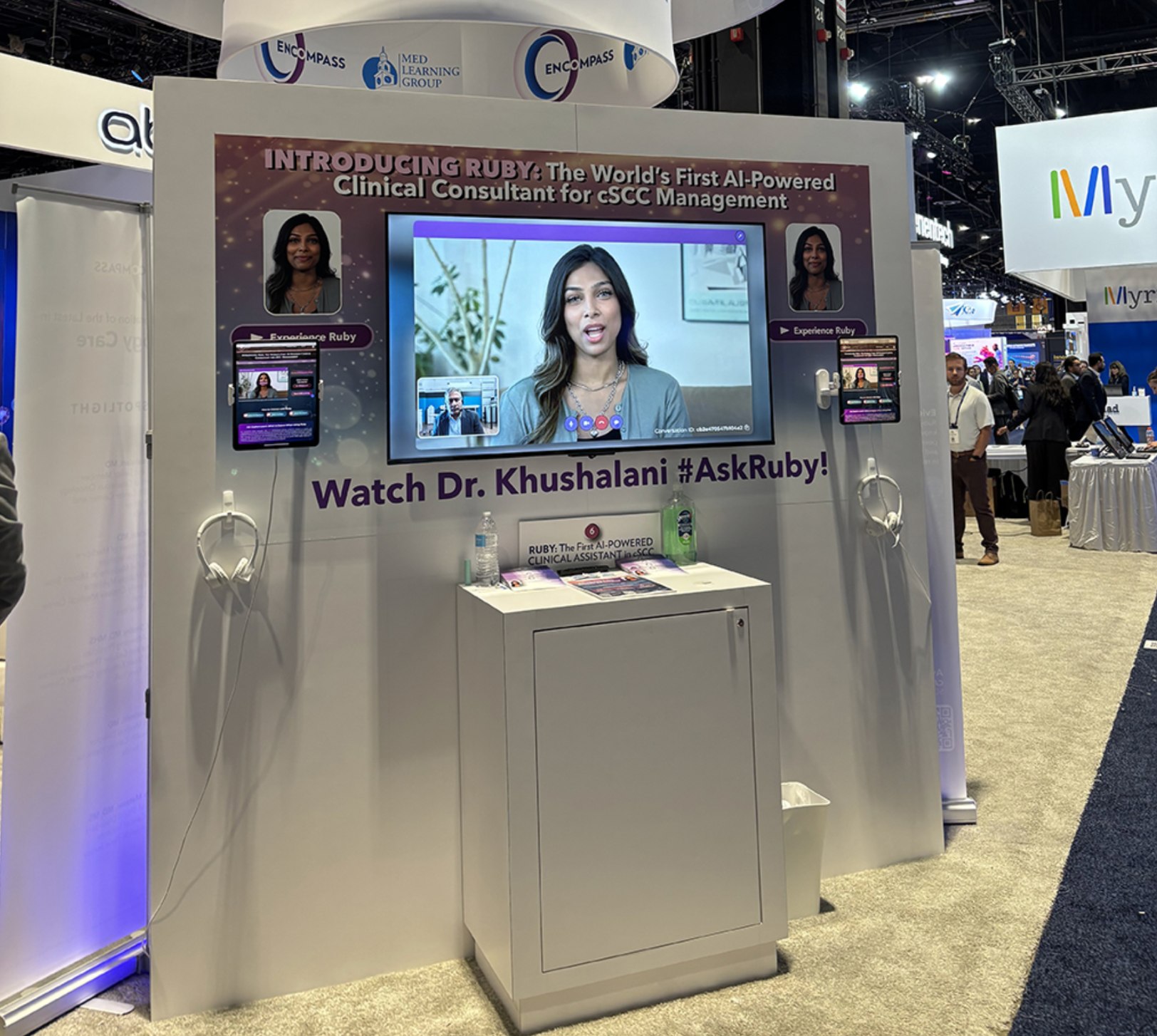
Weeks later, Med Learning Group brought Ruby to ASCO in Chicago, the world's largest oncology conference, and put her at the center of the booth. "We had Ruby at center stage there, answering questions for HCPs right on the floor; people interacting with her, having a lot of fun," Frese explains.
MM+M named the booth one of the 10 most interesting at ASCO 2026, with Med Learning Group competing for floor attention against the industry's largest pharmaceutical exhibits and winning it with a conversation.
For Frese, what happened at that booth is the pattern that matters, because it separates a novelty from a working tool.
"Not just fun; not just engagement, that's kind of the initial draw as they get in," Frese says. "But when they start understanding how smart she is and the types of questions she can answer and the layers of data that she can provide, it becomes not just a fun experience, but something that they really become entrenched in. And then our goal is to see them come back over and over again to utilize her as a service.”
"When they start understanding how smart she is and the types of questions she can answer and the layers of data that she can provide, it becomes not just a fun experience, but something that they really become entrenched in."
In other words, Ruby offers the on-demand opportunity to ask the questions HCPs need answered and engage in bidirectional conversation at any time. This is a prime example of adult learning principles in practice.
Ruby has since become the template for a portfolio-wide program. Med Learning Group is building clinical assistant PALs and synthetic patient PALs across its companies: a cognition-focused clinical assistant, a synthetic patient for practicing difficult conversations, patient PALs for dermatology, and a shared persona library across all of its businesses. A second-generation clinical assistant, embedded module by module inside an accredited activity, is scheduled for Q4.
Frese doesn't credit a benchmark for the decision to work with Tavus. "It wasn't just the technology. It wasn't necessarily about latency or accuracy being better; it was more. Do they understand how important this is, and the critical mission where the companies could come together and understand the trust we had to have and put it forward," he says. "But ultimately, it didn't hurt that Tavus had the greatest capabilities in this space, of all the companies that we entertained working with."
"Tavus had the greatest capabilities in this space, of all the companies that we entertained working with."
He's direct about the limits, too. "Yes, we understand that there are limitations to this technology and human oversight is required," he says. "But the ability to have a bidirectional conversation with an informed consultant at any time, based on a clinician's questions and needs, is truly transformative."
His vision extends past cSCC.
"My vision is to expand AI-powered assistants like her across therapeutic areas and specialties when it is appropriate for clinical care. These tools save time, sharpen diagnostic accuracy, support better clinical decisions, and build confidence when it matters most. And when they are better equipped, patients get better care. That's what this work is all about."
— Matt Frese, CEO & Founder, Med Learning Group
Building AI humans for regulated, high-stakes conversations? Book a demo.
What is conversational AI in continuing medical education?
Conversational AI in CME uses interactive video or voice technology to let clinicians ask questions and receive real-time answers grounded in vetted clinical sources. Instead of reading a static monograph, a clinician talks through a case with a PAL clinical consultant that responds like a knowledgeable colleague.
How does AI in medical training improve on traditional formats like slide decks?
Slide decks and monographs force clinicians to choose between depth and speed; comprehensive materials take too long to search, and quick references skip nuance. Clinical consultant PALs let a clinician ask a specific question and get a targeted answer, then follow up, without paging through a document.
What role does AI play in medical education accuracy and safety?
Tools like Ruby answer only from a closed, curated set of vetted clinical sources rather than the open internet, and they're built to say when a question falls outside their scope instead of guessing. Human oversight remains part of the process; Med Learning Group treats these tools as a supplement to clinical judgment, not a replacement.
Is artificial intelligence in medical education meant to replace physicians or educators?
No. Med Learning Group is explicit that tools like Ruby aren't meant to replace a human. The goal is to give clinicians a resource they can return to at any time, with the personalization and responsiveness that static content can't provide.
What's the future of medical education as AI use expands?
Med Learning Group plans to extend clinical assistant PALs beyond its first use case, building tools across additional therapeutic areas and specialties, along with synthetic patients for practicing difficult conversations. The company frames this as a behavior-change strategy first: better-informed clinicians make better decisions, and patients get better care as a result.
