All Posts
AI, News, and Ethics
Face-to-face conversational AI use cases | 2026
.png)
Written by

The Tavus Team

All Posts
Written by
The Tavus Team
Key takeaways:
Two insurance claims teams deploy conversational AI support in the same quarter. Both reduce staffing costs and cut average response time on routine inquiries. One also reports a meaningful lift in policyholder satisfaction on complex claims. Their conclusion: the conversations that moved the metric were the emotionally charged ones, where a customer was stressed, confused, or filing a first notice of loss after something went wrong. Those conversations went better when there was a face in the room.
That pattern holds across every industry this article covers. Some conversation types produce different outcomes depending on whether the person on the other side can see and be seen. Identifying those conversations, and matching the right modality to each, is the most actionable AI deployment decision most organizations are still working through.
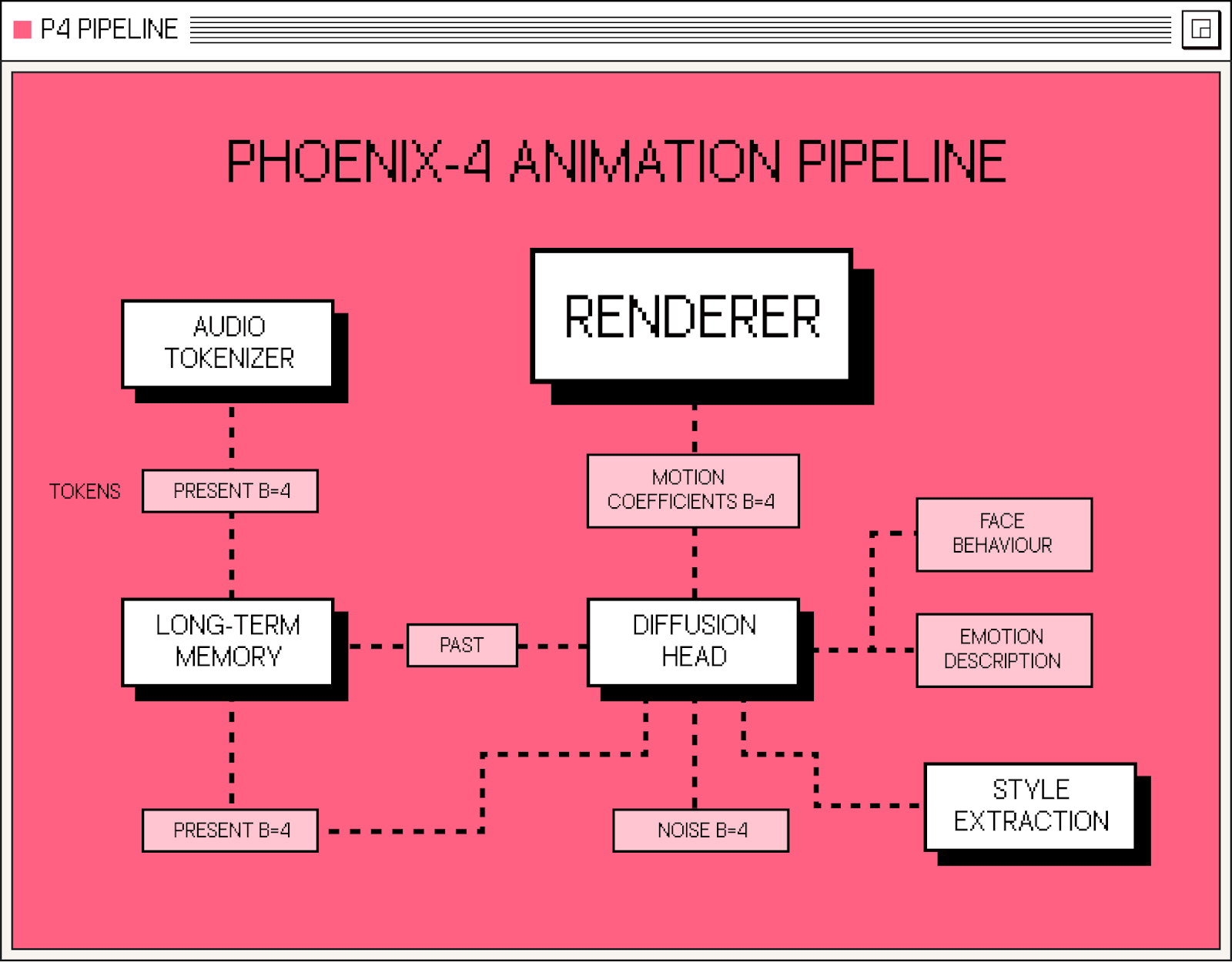
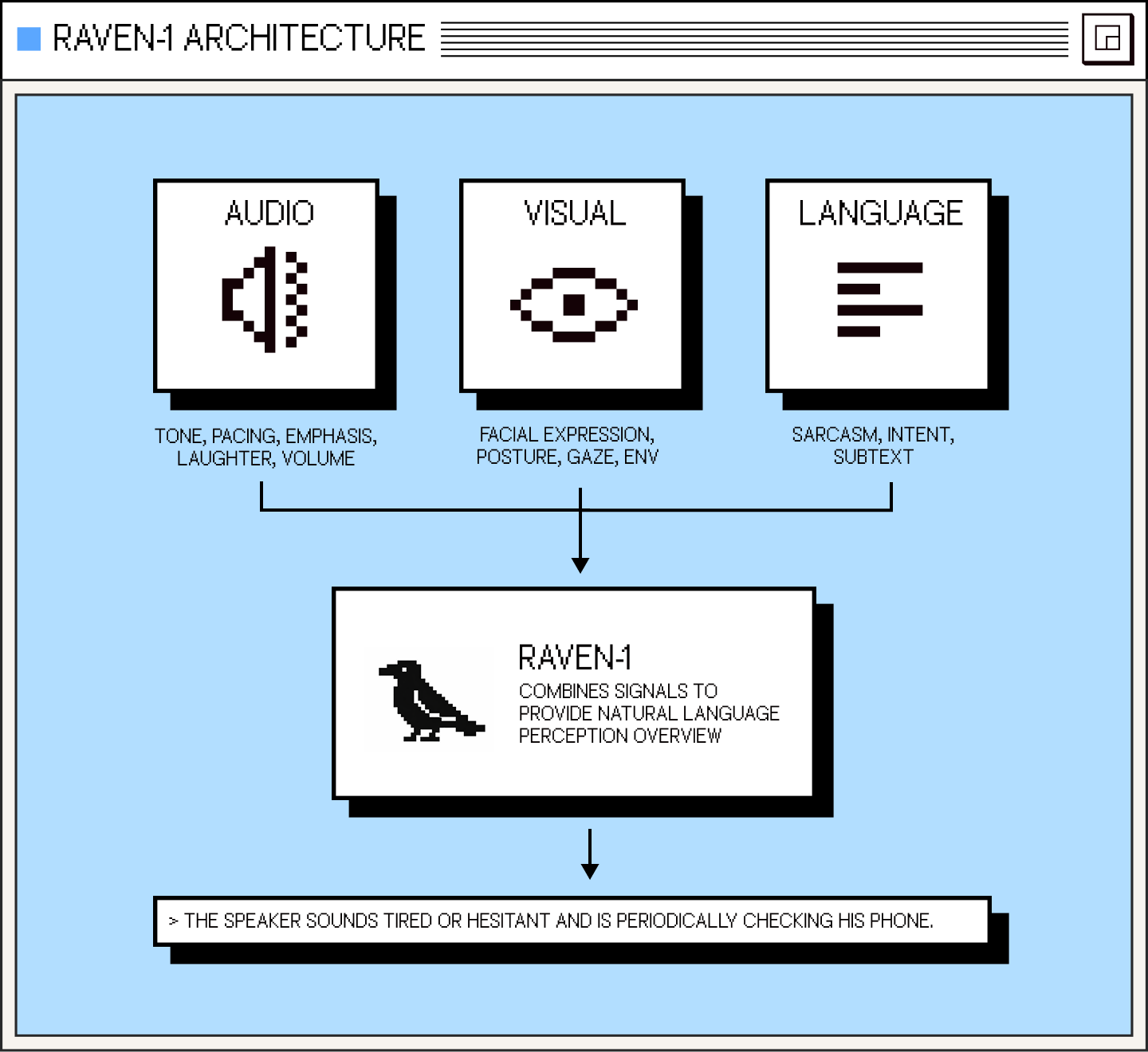
Tavus provides the real-time conversational video infrastructure for that layer. Its Conversational Video Interface (CVI) exposes a four-component behavioral stack through APIs: Raven-1, the multimodal perception system, fuses audio and visual signals to understand the user's emotional state and intent; the LLM intelligence layer reasons about what to say and do next based on that perception; Sparrow-1, the conversational flow model, governs when to speak, hold back, or wait; and Phoenix-4, the real-time facial behavior engine, renders emotionally responsive expression and active listening behavior in real time. Product teams build on these APIs to deploy AI Personas that see, hear, understand, and respond with human-like timing.
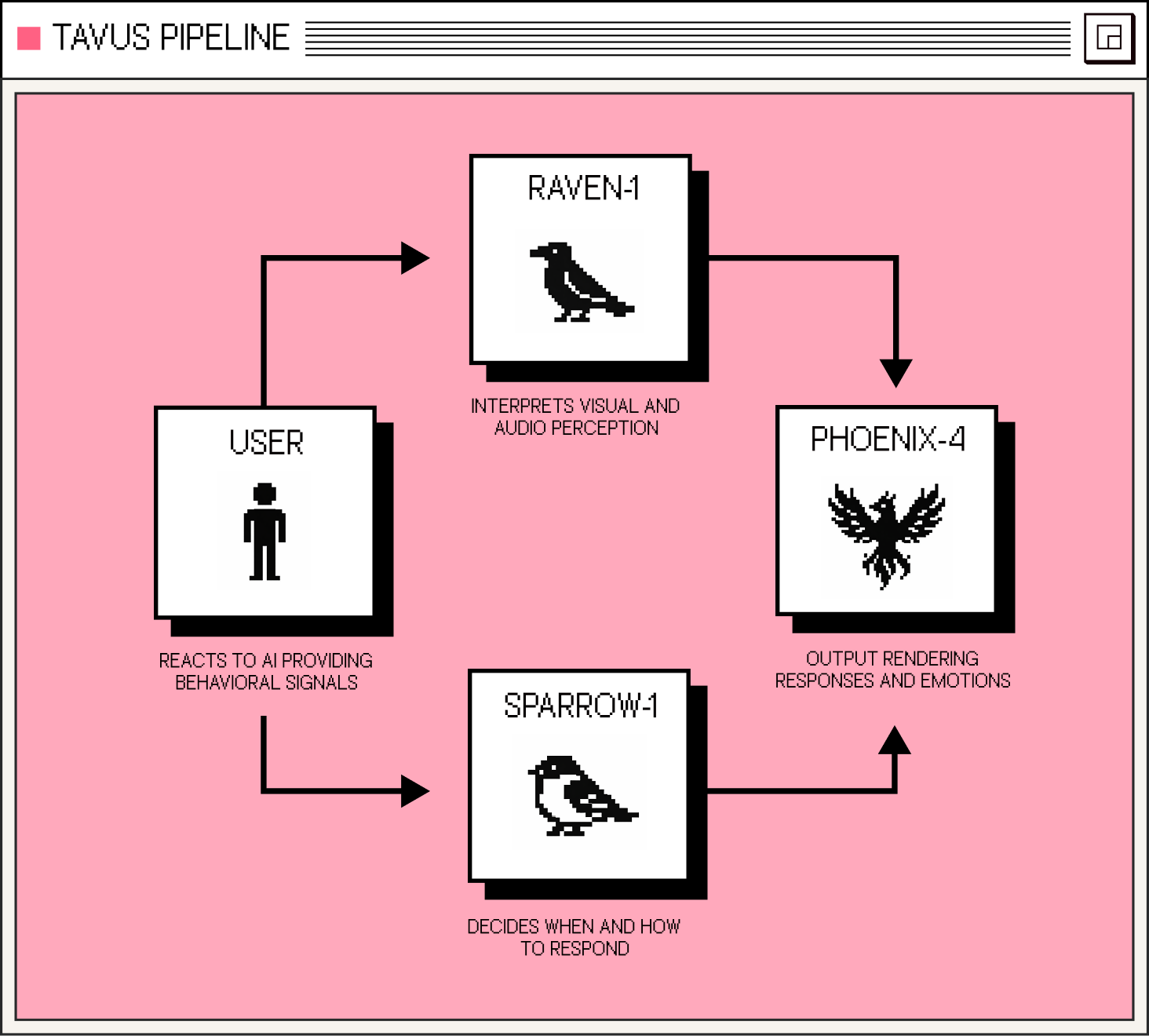
In this article, we'll explore conversational AI use cases across text, voice, and face-to-face modalities, and where adding visual presence changes outcomes.
Conversational AI use cases span every major industry, creating measurable improvements in efficiency and user experience. The use cases below cover the full range: text and voice for transactional interactions, face-to-face for the conversations where presence, trust, and emotional intelligence change outcomes.
Text-based chatbots and voice agents handle the bulk of customer service interactions today. FAQ routing, order status, basic troubleshooting, and ticket creation all work well without a face. For these high-volume, transactional exchanges, text and voice conversational AI delivers clear ROI through 24/7 availability and reduced staffing costs.
Face-to-face conversational AI addresses a different tier of support: complex issues involving product walkthroughs, visual troubleshooting, or emotionally charged complaints.
When a telecom customer calls about a billing discrepancy, a Tavus-powered AI Persona can pull up the account through function calling and share its screen to walk through each line item. Raven-1 fuses the customer's vocal tone with their facial expression, catching the moment confusion shifts toward frustration. The LLM intelligence layer registers that signal and adjusts the approach, directing Phoenix-4 to render a more focused, attentive expression while Sparrow-1 slows the conversational pace, giving the customer room to ask clarifying questions rather than plowing through a script.
This is the kind of interaction that builds loyalty. The faster resolution helps too.
Conversational AI already powers lead qualification through chat, automated product Q&A, and outbound sequences that re-engage prospects. AI in sales has matured quickly, and text-based agents handle initial prospect engagement at scale.
Face-to-face adds the most value in high-consideration sales motions: product demos, consultative selling, and prospect education. An AI video agent conducting a product walkthrough can interpret the prospect's engagement signals, adapt the demo flow based on what's landing, and use function calling to book a follow-up meeting in real time.
Consider an AI Persona deployed as an AI SDR on a company's website. A prospect lands on the pricing page and, instead of a static chatbot popup, speaks with an AI Persona who can answer feature questions, pull up relevant case studies, and schedule a calendar booking when the prospect signals buying intent. The face creates presence, presence builds trust, and trust accelerates the pipeline.
Learning platforms already use conversational AI for content delivery, text-based quizzes, and voice-based tutoring. But completion rates tell a different story than retention rates. Static LMS modules get clicked through. Recorded webinars play in background tabs. The conversations that actually build skills — coaching, role-play, difficult conversation practice, real-time feedback — require a face.
Three scenarios show why face-to-face matters more here than in almost any other use case.
1. Sales role-play
A new rep practices a discovery call with an AI Persona acting as a skeptical prospect. The persona pushes back on pricing and throws curveball objections. Raven-1 fuses the rep's vocal hesitation with their facial expression, catching the relationship between how confident they sound and how confident they look. The LLM updates its approach based on those signals: projecting skepticism when the pitch falls flat, genuine interest when it lands. Phoenix-4 renders those expressions on the persona's face, creating the pressure of a real sales conversation. Sparrow-1 controls the pacing of each exchange, pressing forward when the rep holds their ground and holding space when they need a moment to regroup.
After the session, the AI provides specific feedback on objection handling, talk-to-listen ratio, and closing technique.
2. Compliance training
An insurance company deploys AI Personas grounded in its policy Knowledge Base to walk agents through complex claims scenarios. Instead of reading a manual, agents practice the actual conversation they'll have with a real policyholder. The AI Persona presents different emotional states: a frustrated claimant, a confused first-time filer, a bereaved family member filing a life insurance claim. Objectives track whether the agent correctly identifies escalation criteria and completes each scenario within the required steps. Each scenario requires a fundamentally different conversational approach, and the face makes those differences visceral rather than theoretical.
3. Leadership coaching
A manager practices delivering difficult performance feedback. Raven-1 fuses the manager's tone, pacing, and delivery into a single read of their overall approach. The LLM interprets that signal and determines the persona's response: defensiveness when the manager is too blunt, receptiveness when the approach is empathetic and clear. Sparrow-1 governs the conversational rhythm, giving the manager realistic back-and-forth rather than a scripted sequence. This builds awareness and empathy in a way that slides and case studies cannot.
Tavus' Memories track learner progress across sessions, so each coaching conversation picks up where the last one ended. With 42+ language support, global L&D programs deploy the same coaching infrastructure across every region. Note that Knowledge Base currently supports English-language content, which is worth factoring in for teams serving non-English learner bases.
Conversational AI handles appointment scheduling, medication reminders, and basic symptom triage effectively through text and voice. These are transactional interactions where speed matters more than presence. Medical practices that deploy AI Personas for these workflows see immediate improvements in staff efficiency and patient wait times.
Patient communication becomes a fundamentally different challenge when the conversation is emotional, complex, or requires the patient to absorb new information under stress. Post-visit education, pre-procedure preparation, and chronic condition management are the conversations where a face changes outcomes.
Consider a patient recovering from knee surgery who receives a face-to-face check-in from an AI Persona three days after discharge. The persona walks through the recovery protocol and asks about pain levels. Raven-1 fuses the patient's vocal response with their facial expression, catching the wince that accompanies descriptions of range-of-motion exercises. The LLM registers the mismatch between what the patient says and what they show, adjusts the approach, and Phoenix-4 renders empathetic concern on the persona's face. Sparrow-1 holds the conversational pace while the persona offers a more careful demonstration of the correct movement and suggests following up with the physical therapist.
Tavus supports HIPAA compliance on Enterprise plans. Objectives and Guardrails enforce clinical safety boundaries and trigger escalation to human clinicians when required.
Applicant tracking systems handle automated screening questionnaires and basic phone screens. These text and voice tools filter high volumes of applications efficiently, but the candidate experience they create is impersonal, often indistinguishable from filling out a form.
Face-to-face AI Personas conducting initial screenings give every candidate a personalized, interactive experience at scale. The AI Persona greets the candidate by name, explains the role and team, and conducts a structured interview, all grounded in the company's Knowledge Base loaded with role descriptions, culture documentation, and common candidate questions.
Raven-1 fuses communication patterns, engagement level, and non-verbal signals into a richer read of each candidate than a text transcript provides. Sparrow-1's conversational flow control matters here in particular: when a candidate pauses to gather their thoughts before answering a difficult question, the system holds the floor open rather than jumping in with the next question, creating the patient, respectful cadence of a good interviewer.
The candidate gets something in return: a chance to ask questions and hear about company culture from an AI Persona created as a Replica of the hiring manager or a branded company representative, with function calling that can schedule the next-round interview directly in the conversation.
Insurance is a natural fit for conversational AI given the industry's high call volumes and early adoption of voice agents. IVR systems and chatbots already handle policy FAQ, claims status inquiries, and basic routing effectively.
Insurance conversations are often emotionally charged in ways that text and voice handle poorly. A policyholder filing a first notice of loss after a car accident, or a homeowner calling about storm damage, needs more than a form and a confirmation number. An AI Persona who can perceive the policyholder's distress and respond with appropriate empathy changes a painful administrative experience into one that builds loyalty.
Consider the homeowner claim. The AI Persona guides the policyholder through documenting the damage, using screen share to show where to upload photos. It explains coverage limits using the Knowledge Base loaded with their specific policy terms. Raven-1 fuses the policyholder's vocal and facial signals, catching the moment they become overwhelmed. The LLM updates its approach, directing Sparrow-1 to slow the conversational pace, simplifying language and offering to schedule a follow-up at a better time.
The economics shift too. Hiring and training claims adjusters scales linearly with conversation volume. Conversational video infrastructure amortizes across unlimited conversations, and the same CVI that powers a claims conversation can power policy renewals, coverage explanations, and first notice of loss across the entire policyholder lifecycle.
Banking chatbots check balances, process transfers, and send fraud alerts through text and voice. Conversational AI handles routine account management well, and institutions deploying these tools see clear cost reductions on transactional interactions.
Financial conversations involving advice, planning, and complex product explanations are different. A client exploring refinancing options or reviewing retirement projections needs to trust the source of the information. A face creates that trust in a way a chat window doesn't.
A bank deploys Tavus-powered AI Personas for initial financial planning consultations. A client sits face-to-face with an AI Persona who pulls up their current loan terms through function calling and walks through three refinancing scenarios. Raven-1 fuses the client's facial expression with their vocal response, catching when they need more time on interest rate implications versus when they're ready to move forward. The LLM adjusts the explanation depth accordingly, while Sparrow-1 gives the client space to process rather than rushing to the next talking point.
Email drip sequences, help docs, and in-app tooltips handle the basics of customer onboarding. Text chatbots answer common setup questions and reduce support ticket volume during the critical first-use window.
Face-to-face onboarding changes the retention equation. Instead of a five-email drip sequence that most new customers ignore, a face-to-face AI Persona walks the customer through product setup within their first session. The persona shares its screen to demonstrate key workflows, answers questions in real time, and Raven-1 fuses confusion signals before they compound, so the LLM can offer help before the customer gives up and churns.
Tavus' Memories allow the onboarding persona to pick up where the customer left off in their next session. If a customer completed account setup but didn't finish connecting integrations, the persona knows and starts the next conversation there, not from scratch.
Static training modules and phishing simulation emails are the current standard. Employees click through annual compliance modules, pass the quiz, and forget the content within days.
Face-to-face conversational AI makes security training visceral. An AI Persona conducts a simulated social engineering scenario: a realistic call from someone posing as IT support, requesting credentials with the friendly-but-insistent tone of a real social engineer. Raven-1 fuses the employee's vocal responses with their behavioral signals, catching hesitation, compliance patterns, or growing suspicion. The LLM updates the social engineer's approach based on those signals, and Phoenix-4 renders the corresponding persuasive expressions on the persona's face. Sparrow-1 governs the conversational flow, making the simulation feel uncomfortably real, which is the point.
Employees practice recognizing and refusing manipulation tactics in a way that a slide deck cannot replicate. Post-simulation, the AI provides specific feedback on what cues the employee caught and what they missed.
Property search chatbots filter listings effectively, and AI handles scheduling and basic inquiry routing. These transactional interactions work well through text.
High-consideration property decisions benefit from a face. A buyer browsing listings at 10 PM connects with an AI Persona who walks them through a virtual tour, answers questions about the school district and commute times (grounded in listing data through the Knowledge Base), and adapts its presentation based on whether the buyer seems excited, hesitant, or overwhelmed. The persona books a showing with the listing agent through function calling, completing the entire interaction in a single face-to-face conversation.
Hotel chatbots handle reservation changes, room service orders, and local recommendations through text and voice. These interactions are well-suited to conversational AI, and most hotel chains have deployed some form of it.
Guest experience is the product in hospitality, and a face-to-face AI Persona acting as a virtual concierge provides the personal attention that distinguishes a great stay. Available in 42+ languages, the persona retains guest preferences across stays through Memories and adapts its warmth and formality based on cultural context. A Japanese-speaking guest connects for restaurant recommendations, and the AI Persona responds in fluent Japanese, references dietary preferences from a previous stay, and makes a reservation through function calling.
Shopping is more intuitive with conversational AI. Customers receive personalized product suggestions based on their browsing history and preferences. The AI guides shoppers through checkout, helps track orders, and manages returns, all through natural conversation. For most retail interactions, a chatbot is the right tool.
High-consideration purchases, furniture, electronics, luxury goods, benefit from a consultative face-to-face experience. An AI Persona acting as a personal shopping assistant shows products through screen share and Raven-1 fuses the customer's expressions with their engagement signals, catching shifts in interest and adjusting recommendations in real time. When a customer comparing laptop models keeps returning to battery life questions, the LLM pivots to prioritize that criterion, the same way an attentive sales associate would in a physical store.
Conversational AI maintains brand presence through automated comment responses, sentiment monitoring, and DM-based sales conversations. AI agents handle round-the-clock engagement, answer product questions in direct messages, and flag issues requiring human attention.
Some brands are beginning to explore face-to-face AI Personas for high-value DM interactions in luxury and financial products, where a face-to-face conversation converts at higher rates than text.
Conversational AI assistants manage daily tasks through natural interactions, from scheduling meetings and sending reminders to coordinating across work and personal calendars. Personal AI assistants handle routine coordination, freeing users to focus on higher-impact work.
The face-to-face evolution of virtual assistants is already emerging through products like Tavus PALs, personal AI companions that interact through text, voice, and real-time video with persistent memory across conversations.
Every conversational AI interaction generates data: customer preferences, feedback patterns, behavioral signals. This data drives improvements in products, services, and experience design, making each generation of AI conversations smarter than the last.
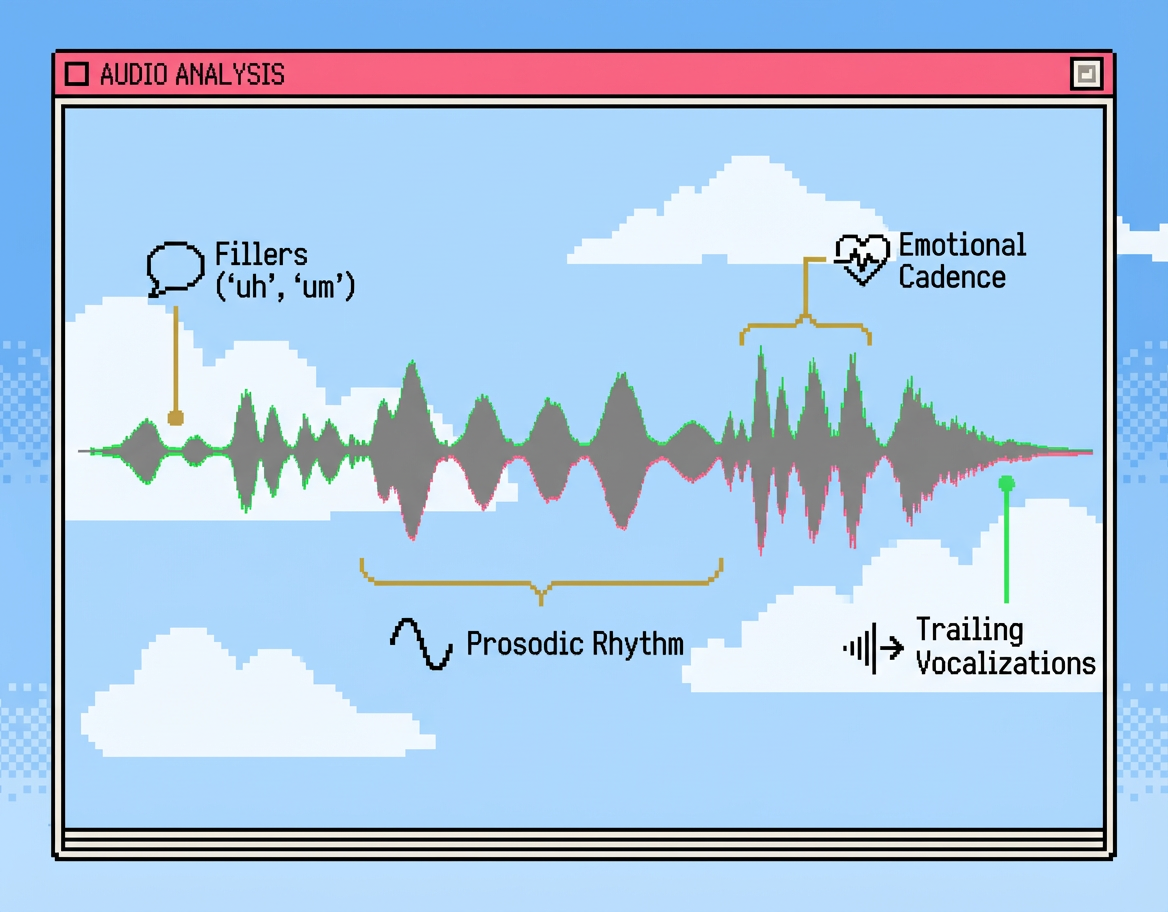
Face-to-face conversations generate significantly richer data. Raven-1's audio-visual fusion captures emotional signals, engagement patterns, and comprehension cues that text and voice miss entirely. When a patient looks confused during a medication explanation, when a sales prospect leans in during a feature demo, when a new hire's confidence grows across coaching sessions, those signals feed back into conversation analytics and inform how organizations design their next interactions.
Conversational AI creates immediate, measurable impact across organizations of any size. The benefits scale with the modality: text and voice handle volume, while face-to-face adds trust, presence, and emotional intelligence to the conversations where those qualities matter most.
Teams accomplish more when conversational AI handles routine interactions. The technology manages customer questions, books appointments, and processes orders automatically, letting employees concentrate on complex projects and higher-value work.
A marketing team using conversational AI can run lead qualification and outreach at scale while AI handles initial engagement, follow-ups, and scheduling. An L&D team deploys AI Personas for sales coaching and compliance training, freeing human instructors for the high-judgment work that requires their expertise.
When those conversations happen face-to-face through infrastructure like Tavus, the productivity gain compounds. A single AI Persona grounded in the company's Knowledge Base can conduct thousands of concurrent coaching sessions, onboarding walkthroughs, or candidate screenings, each one personalized and interactive, without adding headcount.
Conversational AI cuts operational expenses by handling thousands of conversations simultaneously, reducing the need for large support teams during peak periods. The systems improve through each interaction, requiring minimal human oversight to maintain quality.
The economics shift further with face-to-face conversational AI. Hiring and training specialists for high-value conversations, claims adjusters, financial advisors, onboarding specialists, patient educators, scales linearly with volume. Conversational video infrastructure amortizes across unlimited conversations.
Every conversation becomes more relevant when AI adapts to the individual. The system retains previous interactions, tracks preferences, and adjusts responses accordingly. A customer reaching out about a product receives recommendations based on their specific needs and history, not a generic script.
Face-to-face adds a dimension of personalization that text and voice can't match. Tavus' Memories retain context across sessions, so an AI Persona picks up where the last conversation ended. Because Raven-1 fuses audio and visual signals in real time, the persona adapts to what the person says and how they're responding: slowing down when someone looks confused, adjusting tone when someone seems frustrated, holding space when someone needs a moment to process.
Conversational AI serves multiple business functions across industries. Sales teams qualify leads and schedule demos. HR departments screen candidates and answer benefits questions. L&D teams deploy coaching at scale. The applications expand as organizations find new conversation workflows to automate.
The face-to-face layer extends that versatility into conversations that text and voice couldn't reach. The same Tavus infrastructure that powers a patient education conversation in healthcare can power a sales role-play in L&D, a candidate screening in recruiting, or a claims walkthrough in insurance. Product teams build on the CVI and deploy across use cases through the Persona Builder, customizing tone, knowledge, and behavior for each conversation type without rebuilding the underlying stack.
Getting started with conversational AI doesn't have to be complicated. Here's a clear roadmap to help you build your first CVI that works for your tech stack.
Map out where conversations create the most impact and where they don't scale. Prioritize based on two factors: volume (how many conversations per month) and value (what each conversation is worth in time, labor, or business outcome). The conversations that score high on both are where conversational AI pays for itself fastest.
Text works for quick information retrieval. Voice suits hands-free environments and simple routing. Face-to-face conversational video fits the interactions where trust, presence, and emotional intelligence change the outcome.
Connect your initiative to concrete targets: average handle time, training completion rates, cost per conversation, customer satisfaction. These benchmarks also determine how you'll evaluate vendors. Infrastructure that reports on conversation completion, sentiment, and objective achievement, like Tavus' Objectives and Guardrails, gives you the data to prove ROI.
Evaluate APIs on concurrency limits, latency under load, multilingual support, and customization depth. Look for platforms that support multiple use cases on a single stack. Tavus' CVI API powers coaching, screening, onboarding, and support conversations through the same infrastructure, with the Persona Builder handling behavior and knowledge customization per use case.
Upload existing training materials, policy documents, product guides, and conversation transcripts so the AI draws from accurate, company-specific information. Tavus' Knowledge Base accepts PDF, CSV, PPTX, TXT, and URL uploads with no custom coding or retraining required, with retrieval in roughly 30ms.
Conversational AI restructures human involvement rather than eliminating it. Train your team on how to read AI-generated conversation insights, when to intervene for complex situations, and how to update the knowledge base as policies and products change.
Run your AI through realistic conversation scenarios before going live. Test common interactions, edge cases, and interruption handling. Verify that Objectives and Guardrails keep conversations on track. Fix issues in testing, not in production.
Watch for patterns in user feedback, track KPIs against the benchmarks you set in step three, and update training data as your products and processes evolve. Regular iteration keeps conversation quality high as your deployment scales.
The conversations that matter most rarely get the attention they deserve. A patient leaves post-surgical education without fully absorbing the recovery protocol. A new hire sits through onboarding and forgets most of it by Friday. A policyholder files a first notice of loss and never feels heard. Each of those moments is a gap where presence would have made the difference.
Face-to-face conversational video closes that gap. The organizations seeing the strongest results are matching text and voice to the transactional conversations, and face-to-face to the ones where trust, empathy, and visual presence change the outcome. Those conversations can now scale. See it for yourself. Book a demo.
Conversational AI combines machine learning, natural language processing (NLP), and automation to create human-like dialogue between computers and users. The technology goes beyond simple chatbots by learning from each interaction, adapting responses, and maintaining context throughout conversations. It processes text, voice, or video inputs, determines intent through natural language understanding, manages dialogue flow, and improves over time. The latest evolution adds visual perception and real-time facial behavior generation to the stack, so AI Personas can see and respond to the other person's emotional state in real time.
Conversational AI operates through four core components working together. Natural Language Processing (NLP) analyzes words, phrases, and sentence structure to understand user messages. Natural Language Understanding (NLU) determines user intent and extracts key information. Dialogue management keeps track of conversation context and ensures logical response flow. And machine learning improves responses over time based on successful interactions.
Face-to-face systems add two additional layers: multimodal perception, which fuses audio and visual signals to understand the other person's state, and real-time facial behavior generation, which produces emotionally responsive expression, active listening cues, and natural head movement.
Chatbots follow pre-written scripts and fixed decision trees. They answer basic questions but can't adapt to unexpected scenarios or maintain context between messages. Conversational AI uses NLP and machine learning to understand meaning and intent, learns from each interaction, and handles complex multi-turn conversations. Virtual assistants and AI agents combine conversational abilities with direct action: scheduling meetings, controlling devices, and completing tasks.
Face-to-face conversational AI adds real-time visual interaction to the stack. An AI Persona isn't an avatar with a pre-scripted script; it's a system with perception, timing, memory, and reasoning, where the face is what the user sees and the behavioral stack is what makes the conversation real. This is the progression, not a replacement: each layer builds on the one before it.
Conversational AI specializes in back-and-forth dialogue, focusing on understanding users and providing helpful, contextual responses. Generative AI creates new content from scratch, whether text, images, or code. Modern conversational AI systems often incorporate generative capabilities to produce more natural and varied responses, but the core function remains sustained, context-aware dialogue rather than content creation.
Industries where high-value conversations require trust, empathy, and visual presence see the strongest results. Learning and development is the most validated vertical: coaching, role-play, and practice-based training benefit directly from a face. Healthcare uses face-to-face AI for patient education, intake, and follow-up where comprehension and emotional support matter. Insurance deploys it for emotionally charged claims conversations. Recruiting uses it for candidate screening where communication skills and presence are part of the evaluation. Financial services uses it for advisory conversations where trust directly affects conversion.
Companies across industries deploy conversational AI for measurable results. Bank of America's Erica assistant processes account questions and transactions through text. Cleveland Clinic's MyChart Care Companion helps patients manage appointments and medication schedules through natural conversation. Duolingo's AI tutor adjusts language lessons based on individual performance for over 500 million users. On the face-to-face side, enterprises are deploying real-time conversational video for sales coaching, patient education, candidate screening, and claims support through infrastructure like Tavus' Conversational Video Interface.