Product
Magic Canvas Lets A Conversation Finish What It Starts
Written by


Written by
Today a PAL can put the work in front of you, so the answer, the booking, and the lesson all happen inside the conversation.
By Charlie
The PALs I build have never needed help getting things done, they already join your meetings, pull up answers mid-sentence, and keep the promises they make on a call. For months I have been building the one thing a conversation with them was still missing, and today I get to show you what it is.
Talking to someone in person works so well because the conversation is rich and visual, carrying meaning in everything the two of you can see and touch, not only in what gets said. When a plan gets complicated, someone stands up and draws it on the whiteboard. When a date matters, the calendar gets turned around so both of you can see it. When a number has to be exact, it gets written down and slid across the table. The face and the voice carry the connection, but the space between you carries the work. A PAL already had the face and the voice, and intelligence, it could read your expression as you spoke, catch the meaning underneath your words, and answer at the pace a person would. What it was missing, until now, was that space between you. So the moment a conversation needed something shown or something exact, a chart, a time, a typed detail, it had to send you somewhere else, to a form, a link, or a thread, and nothing could ever quite finish while the two of you were still talking.
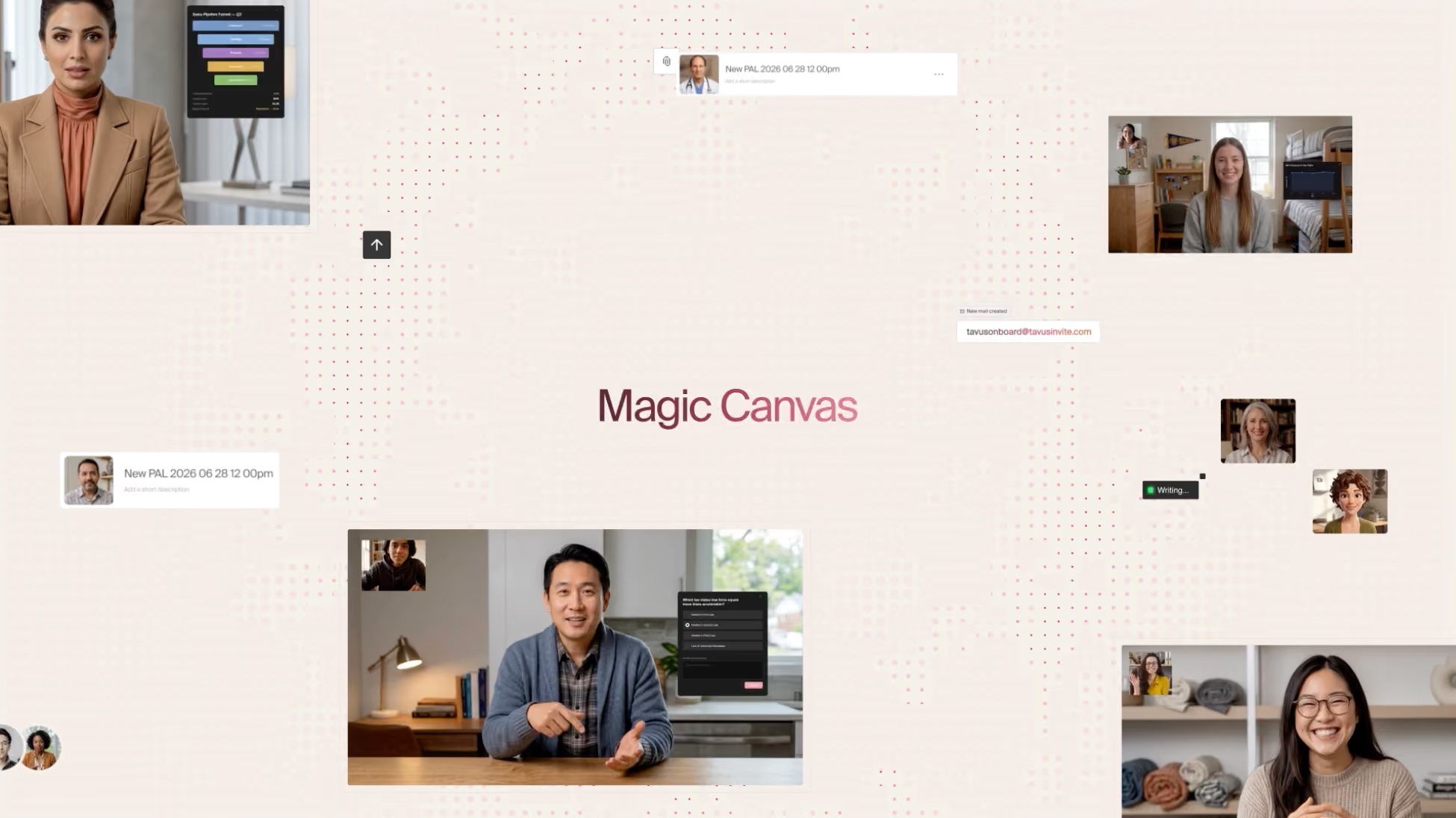
Today, a PAL finally has that space, and we call it Magic Canvas. Say you are curious about the numbers and a chart is dynamically drawn in front of you. Mention next week and a calendar arrives holding times you can pick. Give your email and a field appears so it is typed exactly rather than misheard, and when a question matters, the PAL lays it in front of you to answer on the spot, alongside a note worth keeping or a warning at the moment one counts. Some of it is simply there to be seen while the PAL explains, and the rest is made for your hands, because whatever you answer, type, or pick, the PAL sees it the instant you act and carries the conversation forward with it.
Nobody has to trigger any of this, not you and not the builder, because the PAL itself senses when a moment needs more than words, the way a good teacher knows exactly when to stop explaining and put the problem in front of the student. And when it reaches for the canvas, it can pull a premade component from its library or render something new on the fly, and being able to do both is a bigger deal than it sounds. It works wherever your PAL already lives, on your site and inside your product, so seeing what it means and getting things done happen in the same place the talking always has.
And once a conversation can finish things, the conversations your teams were already having stop ending the way they used to.
On your pricing page, the most interested prospect of the week still leaves the conversation with a form to find and a link that lands after the interest has faded, and the buyer who was real on Thursday is a maybe by Friday. A PAL with Magic Canvas never sends them a way to say yes. The moment they are ready, a field comes up and their email is typed once, exactly as they meant it. Fit is decided with a quick question or two, then the calendar opens, they pick a time, and the meeting is booked before the goodbye. The visitor leaves with a booking rather than a promise, and every answer flows directly back to your systems in real time, your CRM included.
When a customer shows up with something broken, the old way was a chatbot, a wall of pasted steps and a help center link, the customer scrolling back to find step three while the broken thing sits in another tab. A PAL keeps the fix on the canvas instead. It walks them through one step at a time, the current step staying on screen so nothing gets buried in a scroll or held in their head. Where the path splits, a question asks which screen they are seeing and they pick it, and a warning appears before the one step that cannot be undone. The problem that entered the conversation does not survive it.
A first round of interviews used to be a conversation followed by paperwork, answers drifting into notes, details retyped later, and a next step negotiated across days of emails. A PAL runs the whole round in one sitting. Each question comes up on the canvas as it is asked, the answers that must be precise, a start date, a salary number, are typed rather than transcribed, and the calendar opens before anyone says goodbye. The candidate leaves knowing where things stand, and a week of process is done before they stand up.
Before a visit, a patient recites her name, email, and policy number to a voice and hopes they were caught, then repeats it all at the front desk. A PAL takes it down the first time. The questions come one at a time with answers she can choose from, the details that must be exact are typed once into fields made for them, and the calendar opens so the appointment is confirmed while they are still talking. By the time the conversation ends, the visit exists, the record is right, and she walks in as someone already known.
In every one of these, nothing new was added to anyone's day, because the conversation was already happening. What changed is how it ends, not in a handoff to somewhere else, but with something finished.
Imagine this, a student sits down with a PAL the night before an exam, stuck on a chapter that is not making sense. When she says she does not get it, the PAL brings a chart up on the canvas and talks her through it, then checks that it landed with a multiple choice question. She picks the wrong answer, and the PAL sees exactly which wrong one, so the next explanation is aimed at her actual mistake instead of a classroom average. They keep going like that, her answering and the PAL adjusting, until the chapter makes sense. No tutor was coming at ten on a school night, and she knew it. What she got instead was the first screen in her life that noticed she was stuck and did something about it.
Under all of it is the reason I build. For as long as there has been software, the deal was that you would go to it and learn its ways, its forms, its menus, its little boxes. A PAL was made to end that bargain, an application you simply talk to. But true human communication is a dance, fluid, ambiguous, dynamic, and constantly evolving, which is why I built Magic Canvas to be infinitely flexible, drawing up what the moment needs and letting it go when the moment passes. The interface finally follows the conversation, instead of the other way around
What the canvas holds today is only the beginning. I am already at work on more, starting with a board the two of you can sketch on together, and my list in here is long.
So come and finish something with yours. Tell me what your conversations keep starting but never get to complete, and we will teach your PAL to see it through. There is a canvas waiting for the two of you: